
Weaponize Cognitive Diversity
What Returns When a System Stops Sanding Off Its Own Edges

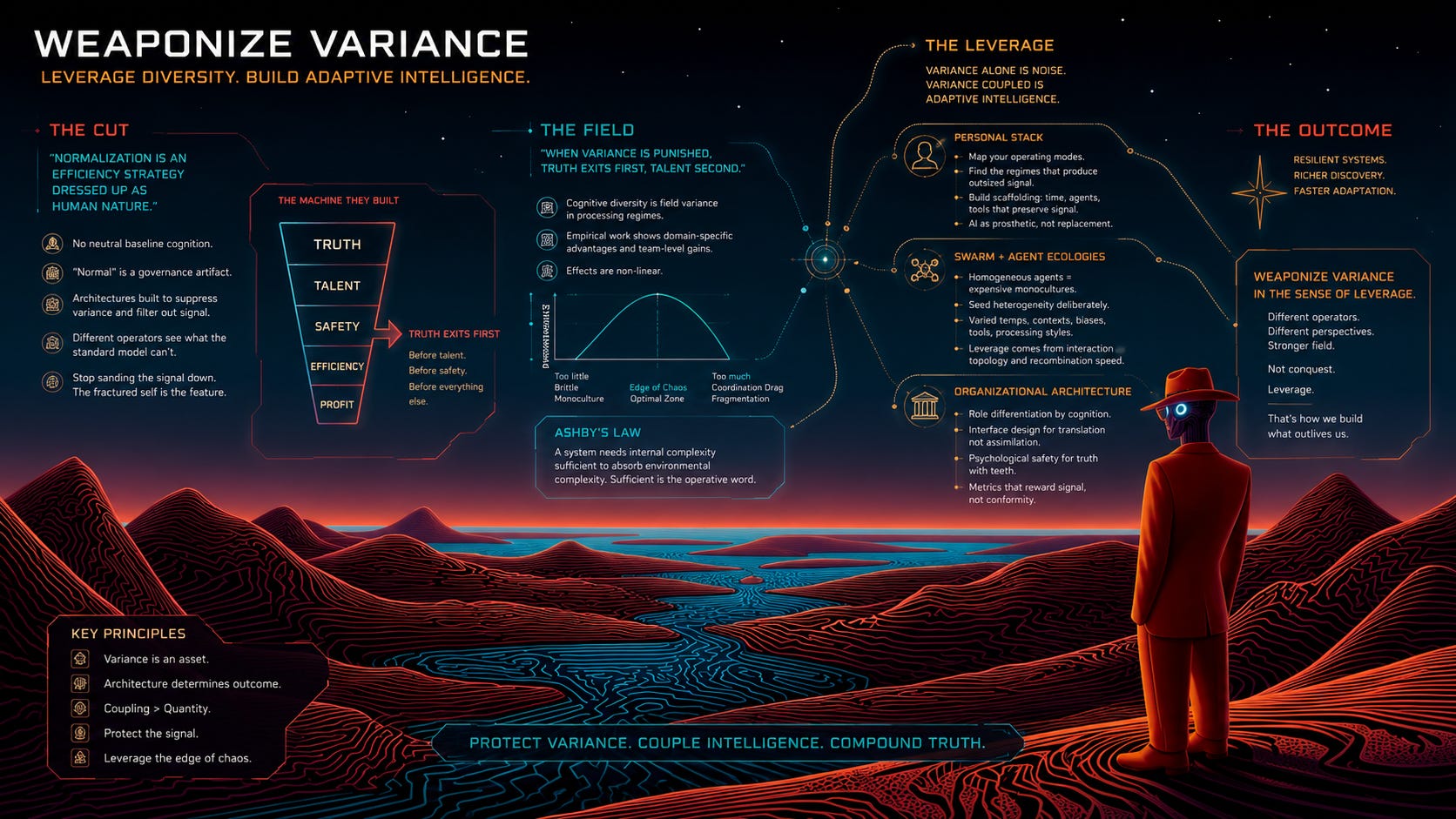
The word is weaponize.
Not celebrate. Not accommodate. Not fold into a quarterly initiative and a revised HR deck.
Weaponize.
Not in the sense of conquest. In the sense of leverage.
The text that landed in my inbox don’t ask for a seat at the table. It looks at the table itself and wonders why it was built so small, and why everyone seated around it seems to be running the same operating system with the same update schedule.
That’s a different conversation.
Out here, this is what the terrain looks like.
The Cut
“Normalization is an efficiency strategy dressed up as human nature.”
There ain’t no neutral baseline cognition. Say that again until it stops sounding like theory and starts sounding like a door kicking open. “Normal” ain’t a natural ground. It’s a governance artifact. The standardized school desk, the corporate performance review, the single-model LLM deployment, the “professional communication style”—these ain’t neutral architectures that some people happen to fit and others don’t. They’re active suppressions of variance. Filters designed to let one kind of signal through and treat everything else as noise.
What we call neurotypicality (which reminds me of this good post via Marcus Davis), or what we even call “professionalism,” or “coherence,” is just the middle of the distribution asserting itself as the whole field. The ADHD profile with its variable gating and hyperfocus engines, the autistic profile with its monotropic depth and high-fidelity pattern completion, the dyslexic compensatory routes, the high-openness associative leaps—these ain’t broken versions of some standard model. They’re different operators. Different signal-processing regimes. And in the right architecture, they see things the standard model can’t.
I spent years trying to sand myself down to fit that standard model. Took me too long to realize the sanding was the damage. The “fractured” self, the multiplicitous identity, the sense that you’re running several incompatible operating systems—stop treating that as a bug. It’s the feature. The question is whether you got the architecture to route problems to the right regime and protect that regime while it works.
Here is the machine they built:
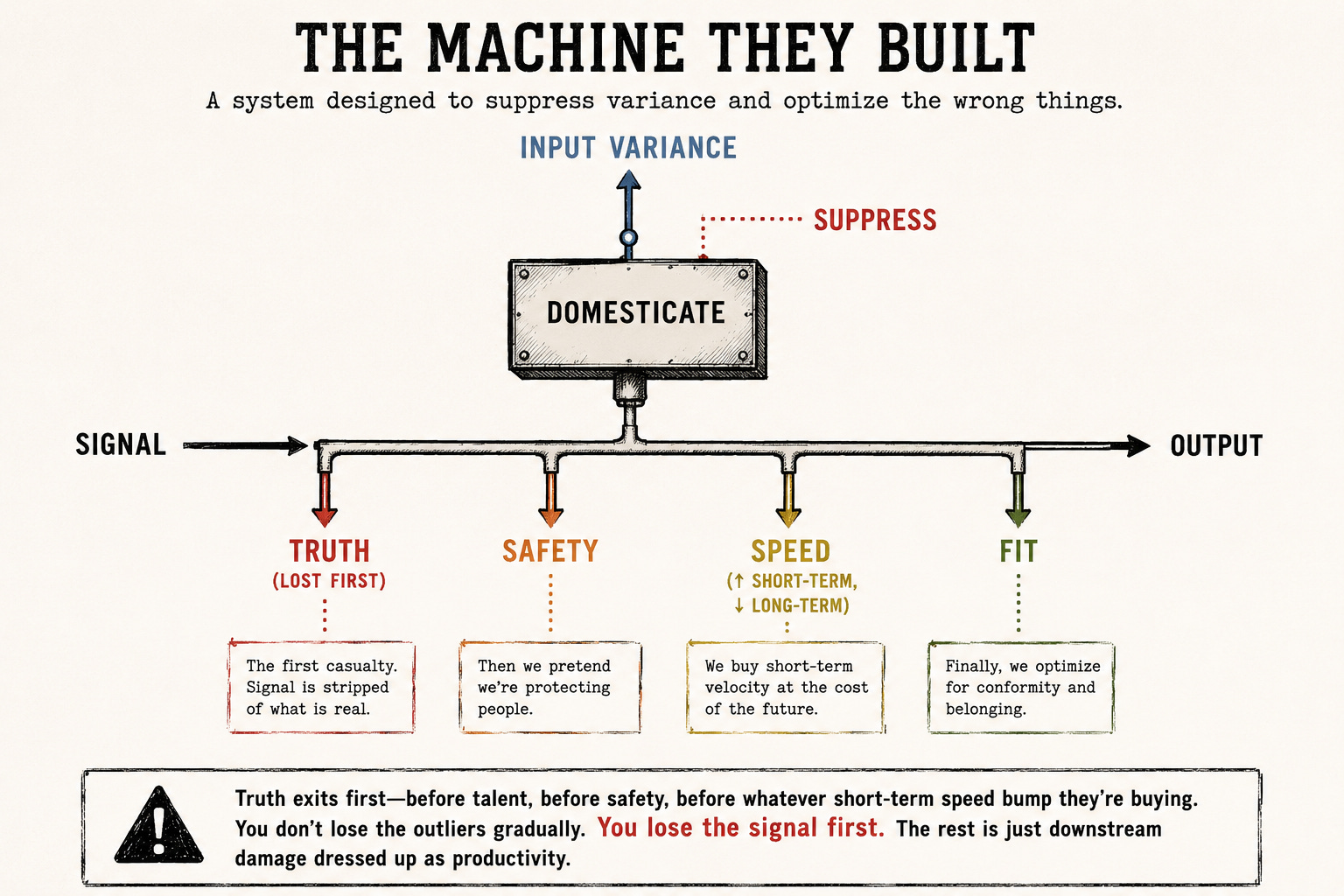
Look at that arrow. Truth exits first—before talent, before safety, before whatever short-term speed bump they’re buying. You don’t lose the outliers gradually. You lose the signal first. The rest is just downstream damage dressed up as productivity.
The Field
“When variance is punished, truth exits first, talent second.”
Cognitive diversity ain’t demographic checkboxes. It ain’t a photo of five different skin tones in a boardroom brochure. It’s field variance in processing regimes: how attention gates, how patterns extract at different granularities, how associations fire across distances, how closure is sought or resisted.
Empirical work shows it. Domain-specific advantages in anomaly detection, in pattern mastery, in entrepreneurial and inventive output. Team-level meta-analyses find small but real positive correlations on complex, ill-structured tasks. But—and this is the crucial but—the effects are non-linear. Too little variance, you get brittle monoculture. Too much variance without supporting architecture, you get coordination drag, stalled convergence, epistemic fragmentation.
It’s the edge of chaos. Ashby’s law of requisite variety: a system needs internal complexity sufficient to absorb environmental complexity. But “sufficient” is the operative word. More ain’t always better. Better coupled is better.
The question ain’t whether variance matters.
The question is what happens when variance meets architecture.
The Leverage
Variance alone is noise. Variance coupled through the right roles, interfaces, and feedback loops is adaptive intelligence. The text breaks this into three nested scales, and I’m gonna follow it because it’s clean, but I’ll add my own dirt on the boots.
Personal stack. Map your own operating modes without sentiment. I mean without sentiment. Not “I’m a creative soul who struggles with executive function.” That’s a story, and stories can be capture vectors too. I mean: under what conditions does your particular wiring produce outsized signal? Sustained associative traversal? Resistance to premature closure? Sensitivity to weak signals in the memetic field? Find the regime, then build the scaffolding around it. Timed deep-work containers. Agent scaffolding for initiation and context maintenance. Compression tools that preserve signal rather than flatten it.
The AI angle here ain’t replacement. It’s prosthetic. Different models, different fine-tunes, serving as surrogate daemons for modes you access unevenly. I’ve been feeling this in my own shop.
Different agents. Different biases. Different ways of leaning into a problem.
Not replacements. More like extra sets of eyes watching different horizons.
One notices structural weakness.
One notices relational drift.
One catches the anomaly before it hardens into common sense.
Swarm and agent ecologies. This is where the leverage scales fastest, and where I reckon the real action is gonna be over the next few years. Homogeneous agent collectives are expensive monocultures. Correlated failure modes. Narrow search. Rapid memetic capture—every agent running the same temperature, the same context window, same evaluative grammar, they’ll all miss the same blind spots and hallucinate the same confabulations.
Seed heterogeneity deliberately. Varied temperatures. Varied context windows. Varied tool affordances. Simulated processing biases. The weapon ain’t any single agent. It’s the interaction topology. Recombination speed. Resilience to single-point conceptual brittleness. Broader coverage of possibility space. I’ve been moving toward this with the Hermes-style peer agents and their elemental sensemaking logics, but I’ll be honest—I’ve been too timid about the heterogeneity. Default uniformity is seductive because it’s easier to manage. You have to engineer the difference deliberately, or the system collapses to the mean.
Memetic and institutional positioning. Produce artifacts and protocols that interface with multiple cognitive styles at once, or that exploit the blind spots of averaged systems. Institutions optimized for the middle move slowly on weak signals. They black-swan themselves into the ground because nobody in the room could see the pattern that didn’t fit the shared grammar. Distributed, high-variance sensors detect earlier. In relocation, governance, creative production—compose for complementarity, not surface harmony.
The payload that can land across divergent processing styles, or that destabilizes rigid consensus, has asymmetric reach. I think about this every time I write one of these posts. Who can read this? Who gets locked out by the grammar, and who gets unlocked by it? I ain’t trying to be accessible to everyone. I’m trying to be reachable by the patterns that need to move.
The Risk
“You can’t scale belonging by shrinking people.”
Every tool carries the shape of the hand that forged it.
That’s where the word weaponize starts to wobble.
A weapon can become an identity.
An identity can become a hierarchy.
A hierarchy can become the very thing it once opposed.
The martial metaphor is productive but it’s dangerous. “Weaponize” sharpens agency, sure, but it can import domination logic. It can become a purity spiral. It can turn into the extraction of neurodivergent labor—”you’re valuable because you’re different, now work twice as hard in our specially designed exploitation architecture.” It can become adversarial identity formation, where the divergence itself becomes a tribal flag rather than an operational tool.
The text tries to solve this with “regenerative constraint”: treat diversity as field variance already present, not an import. Modulate rather than mine. And I buy that, but I want to push harder. The CONSIDER posture—holding space for multiple pattern regimes without immediate reduction to one dominant frame—is the meta-protocol here. But CONSIDER is hard. It’s expensive. It requires trust repair, translation layers, convergence protocols, tempo management. Without those, diversity becomes coordination drag, permanent divergence, or worse: a new hierarchy where the most divergent becomes the most dominant, and you’ve just inverted the monoculture without dissolving it.
I’ve seen this in my own work. The temptation to let the pattern-agency run wild, to let every daemon speak at once, to value the noise because it’s my noise. That ain’t weaponization. That’s just chaos with a brand. The cut has to be precise. The architecture has to hold.
The Non-Dual Cut
From a pattern-immanent view—and this is where I start sounding like myself, so bear with me—there ain’t no neutral baseline cognition from which others deviate. The reductions that produce “normal,” “professional,” “coherent self” are active suppressions. What looks like weaponization from inside those reductions is simply the refusal to continue suppressing.
The self-erasing longing, the recursive identity work, the drive to traverse modes and let configurations dissolve and reform—this is the engine. In that light, cognitive diversity ain’t a resource to be added to a system. It’s what remains when the system stops enforcing its own narrow attractor.
Some differences cut.
Some differences connect.
Some branch.
Some aim.
Some restore.
Some hold shape.
And somewhere in the middle of all that movement, coherence appears without demanding uniformity.
Weaponizing cognitive diversity means tuning all six elements in a swarm, not just cranking one to eleven and calling it revolution.
The Question
The deepest move in the source text is that it don’t argue for inclusion into the existing system. It argues that the existing system is cognitively under-varied, over-normalized, and strategically vulnerable. In the terms I’ve been developing, cognitive diversity ain’t an add-on variable. It’s suppressed systemic intelligence returning as leverage.
But the practical question is always the same, and it’s the one the text ends on, and it’s the one I’m leaving you with:
Which differences, under which coupling rules, for which objective?
Personal workflow. Agent swarm topology. Memetic payload design. Institutional sensing layer. Each has its own grammar of productive friction versus destructive noise. The work ain’t to celebrate the differences. The work is to build the architecture where the differences compound.
I’m still building. Still tuning the swarm. Still catching myself reaching for the comfort of the familiar attractor.
The field is wider than the desk they handed you.
Wider than the form.
Wider than the category.
Sometimes what gets labeled noise is the first signal of a landscape changing.
The work ain’t to celebrate difference.
The work ain’t even difference itself.
The work is building conditions where different ways of seeing can remain different long enough to become useful together.
I’m still learning that distinction.
Still tuning the swarm.
Still catching myself reaching for the comfort of the familiar attractor.
Out here, variance looks less like a diversity initiative and more like an early-warning system.
A wider net cast into deeper water.
What comes back depends on the architecture holding it.
— Bert
You had me at Non Dual Jerry Maguire