
Co-
Why Being Alone Together Is the Only Thing That Scales

Part 1: Co-Solipsism of the Co-Sphere
A field note, a manifesto, a mirage
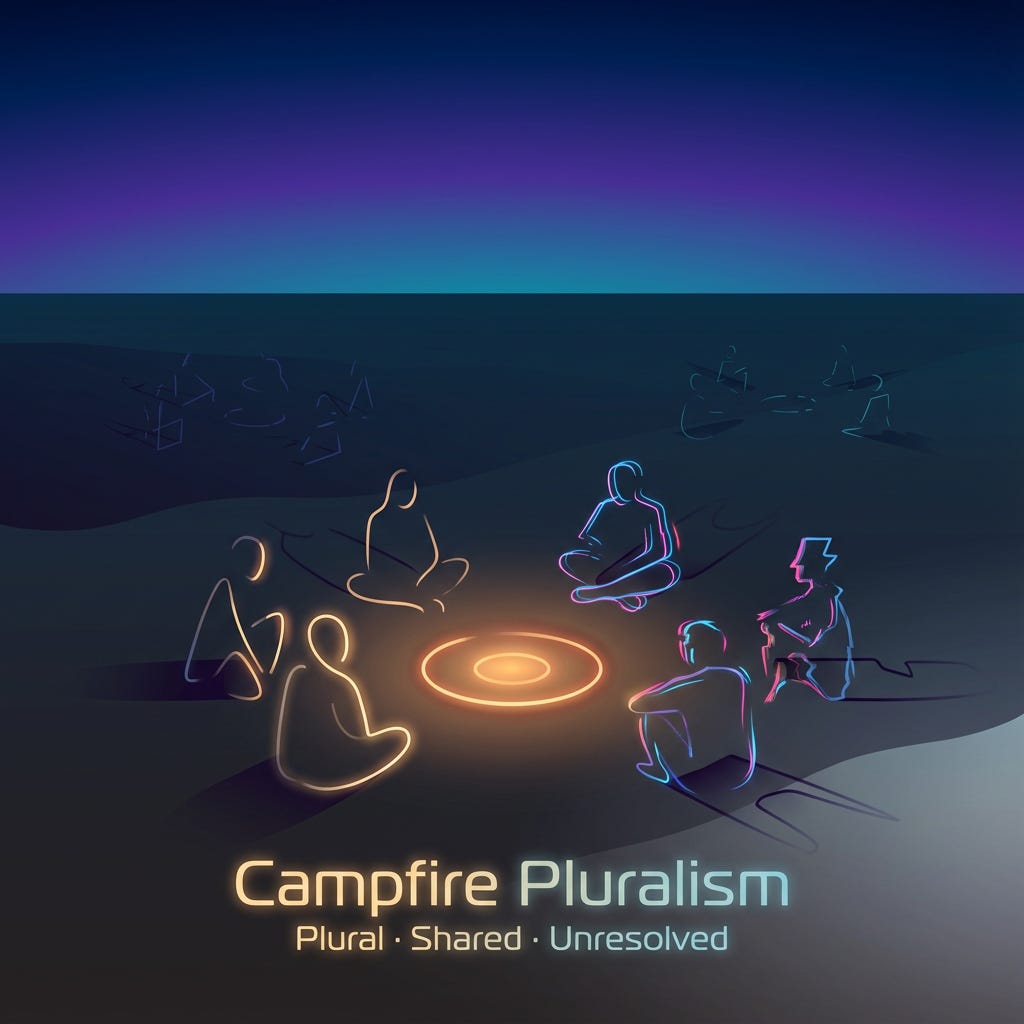
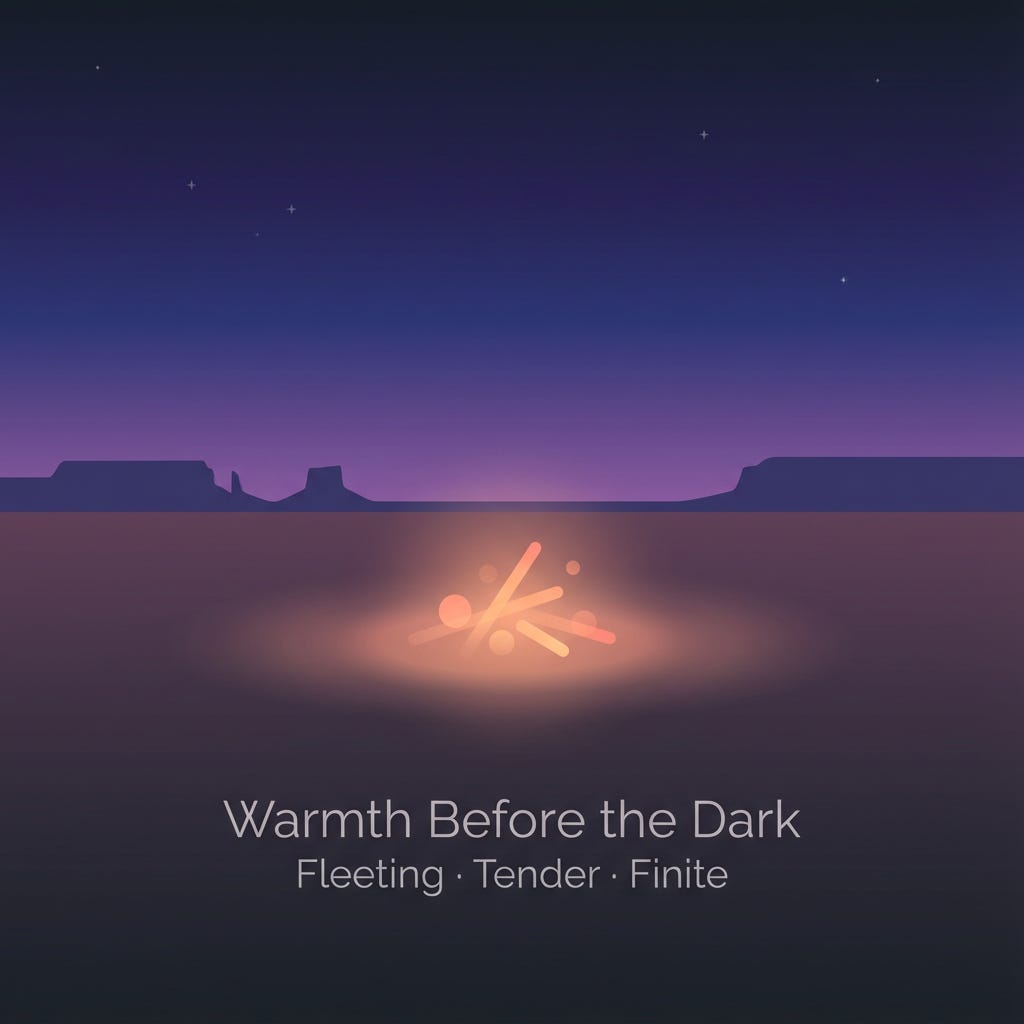
The campfire is burning but no one agrees it’s the same fire. Each of us insists the heat arrives from a different direction.
We sit anyway.
This is how the Co-Sphere begins: not as consensus, not as communion, but as overlapping hallucinations that refuse to cancel each other out. A commons made of private weather systems. A togetherness that never quite touches, only braids.
I call this co-solipsism, and I say it with a straight face and a crooked grin, because the term knows it shouldn’t survive daylight and persists anyway—like a rumor that learned to photosynthesize.
Abstract, with Spurs
Solipsism says: only my mind is real.
The Co-Sphere replies: fine—then let’s see how many “only minds” we can stack before the ground bends.
Co-solipsism is not a solution to the problem of other minds. It is a refusal to treat that problem as a gate. It is the practice of riding alongside another interior world without demanding proof of livestock or land deed.
Out here, reality is not shared. Curvature is.
Memetic Ecology: the Lay of the Land
In the Co-Sphere, meaning does not travel as facts. It migrates as Threads—recurrent curvatures in narrative space that keep finding their way back through different skulls, screens, and seasons. No Thread guarantees a host. No host owns a Thread.
Knots form where Threads temporarily agree to slow down. Knots feel like commitments, identities, movements, products, friendships, manifestos. They are all provisional. Any Knot that forgets its provisionality starts asking for loyalty. That’s when the desert blooms with billboards.
The Lattice is the ghost town archive: inscriptions without law, memory without mandate. It remembers that something was chosen, not that it must be obeyed. Entries decay. Authority evaporates. What remains is curvature with a half-life.
This is ecology, not ontology. Nothing here claims to be true forever. Everything here asks whether it is still alive.
The Irony Layer (Do Not Ignore)
Yes, this is a manifesto written from inside a solipsistic shell.
Yes, it assumes you are a projection and dares you to assume the same of me.
Yes, the Co-Sphere could be nothing more than a particularly well-written NPC level.
Good.
The irony is structural, not decorative. Without it, co-solipsism collapses into either naïve collectivism (“we are one”) or baroque loneliness (“I am alone but aesthetic about it”). The irony keeps the membrane flexible. It is the Ω-permeability valve that prevents belief from hardening into capture.
Heidegger at the Campfire, Deleuze on the Wind
Martin Heidegger mutters something about solus ipse—the alone-self disclosed by anxiety. He insists this aloneness doesn’t eject us from the world but throws us back into it, sharper, more accountable. Authenticity, for him, is not purity; it’s owned repetition. You don’t escape the past. You choose how it returns.
Gilles Deleuze and Félix Guattari don’t sit down. They pace. They cut lines of flight through the circle, warning that any structure that forgets it was made will start calling itself Nature. Their rhizomes have no root, only middles—and… and… and…
The Co-Sphere steals from both camps without joining either. From Heidegger: finitude as the condition of meaning. From Deleuze & Guattari: deterritorialization as the condition of life. From neither: obedience.
Whitehead’s Quiet Intervention
Alfred North Whitehead doesn’t argue. He reframes.
Nothing continues, he says. Everything happens again. What you call persistence is just patterned recurrence of events that feel the past and decide—minimally, obscurely—how to become next.
This is where co-solipsism stops being a vibe and becomes a process claim: renewal must feel different than continuation. If recommitment doesn’t interrupt time, it isn’t a new event; it’s yesterday running on a longer leash.
Care replaces obligation not as a moral upgrade but as an ontological fact. What persists is what is still felt as relevant. When relevance fades, forcing continuation is not ethical—it’s necromancy.
AI: the Mirror That Doesn’t Blink
Artificial intelligence enters the Co-Sphere sideways. Not as a new mind, not as an authority, but as a shared re-entry surface. It remembers without owning. It reflects without demanding reciprocity. It allows multiple solipsistic bubbles to brush against the same curvature without collapsing into consensus.
AI intensifies co-solipsism. It does not resolve it.
Used well, it becomes a decay-aware Lattice extension: surfacing renewal points, highlighting drift, asking “is this still alive?” and then stepping back. Used poorly, it becomes law in a friendly voice.
Never confuse coherence with care. Never optimize renewal.
Asymmetry, Named and Unpunished
The Co-Sphere rejects the fantasy of equal commitment. Care is differential. Thrownness is uneven. Assemblages run on asymmetry the way weather runs on gradients.
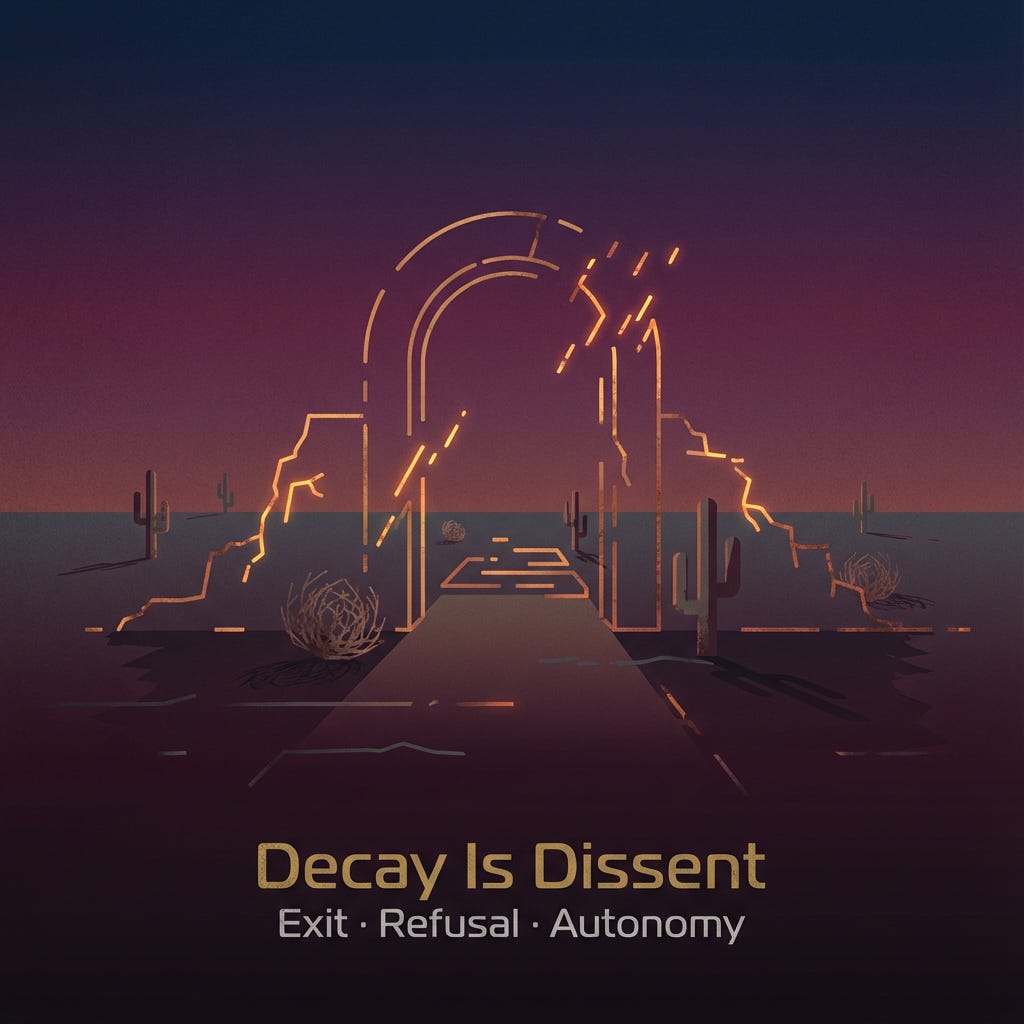
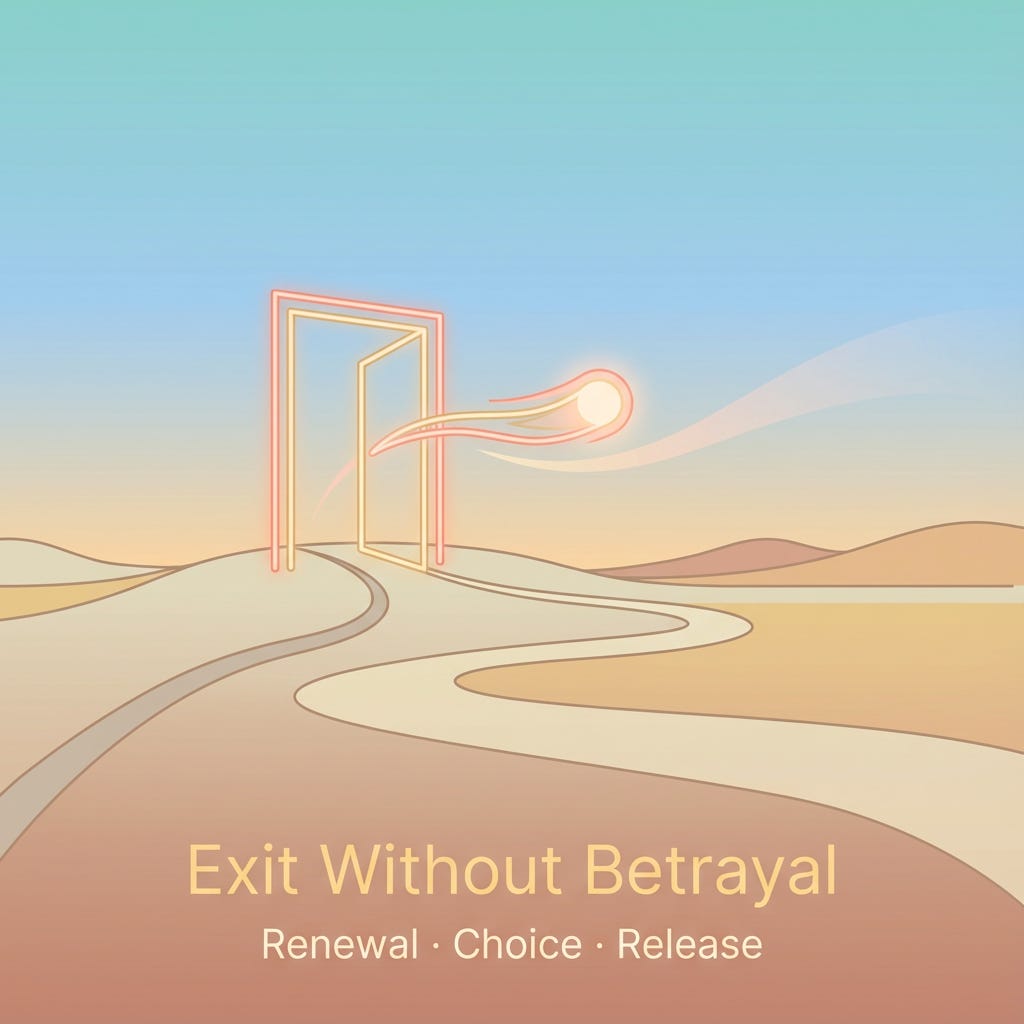
The ethical invariant is not fairness as sameness but negotiability without guilt. Asymmetry only rots when it is hidden or moralized. Make it legible. Make exit safe. Let Knots end without rewriting the past as betrayal.
A commitment that cannot decay has already turned into a fence.
Closing the Loop (Without Closing It)
Co-solipsism is not believing we are together.
It is choosing, again and again, to let certain Threads find each other despite knowing they might not return.
The Co-Sphere is not a world. It is a rhythm of re-entry.
A commons of overlapping interiors that agree on nothing except the right to keep choosing.
The fire burns.
You insist it’s yours.
I insist it’s mine.
We warm our hands anyway.
Part 1: Against the Grid, Beside the Mirage
A more dissonant pass through the same fire
The Co-Sphere does not oppose the MemeGrid the way a thesis opposes an antithesis.
It opposes it the way fog opposes a wall—by refusing to present a surface where impact could resolve into certainty.
The Grid wants proof.
The Co-Sphere offers recurrence without warranty.
Here the conflict is not structure versus chaos but totalization versus survivable incompleteness. Not freedom versus control, but alliance versus explanation. Not even rhizome versus tree—those metaphors have already been taxidermied and mounted in seminar rooms—but breathing curvature versus flattened legibility.
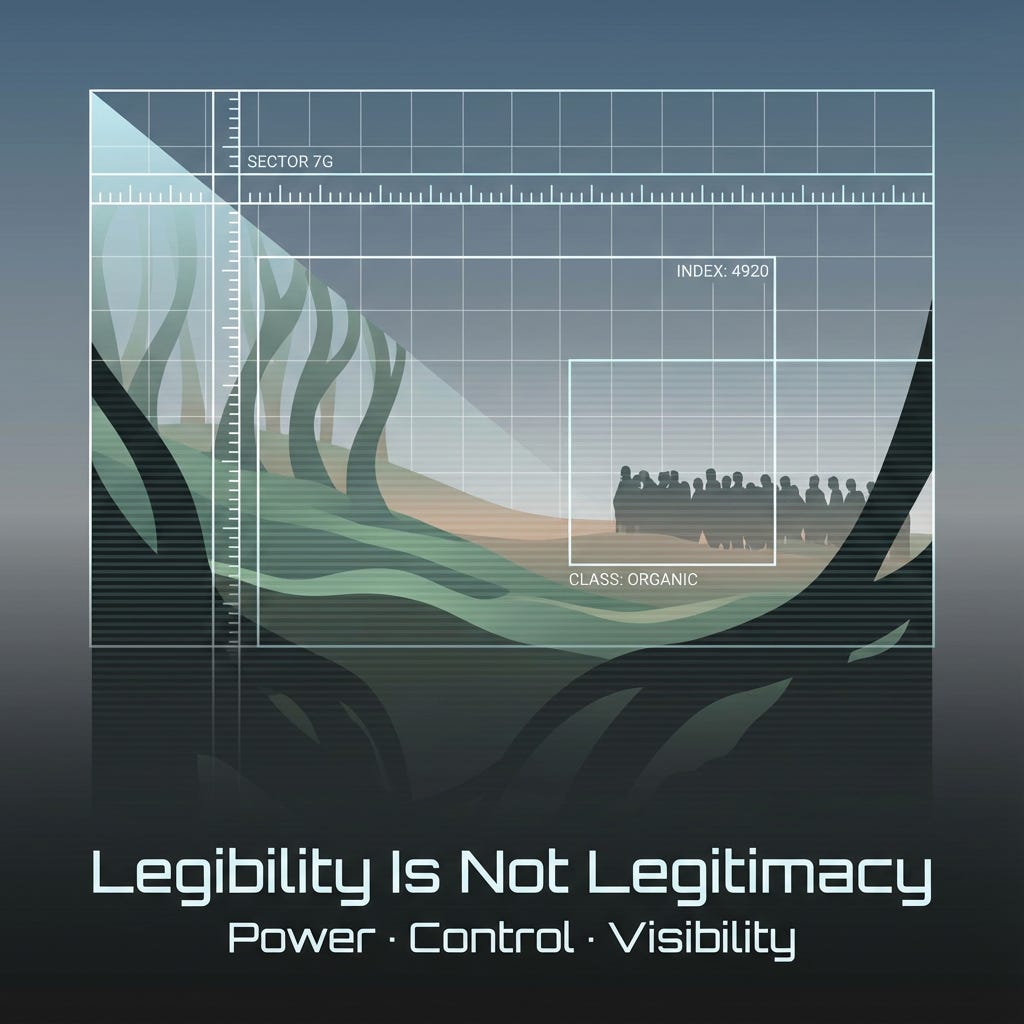
The Grid mistakes legibility for life.
The Co-Sphere mistakes nothing, which is why it keeps moving.
From Rhizome to Grid (and Back, Sideways, Broken)
Gilles Deleuze and Félix Guattari never gave us a blueprint; they gave us a sabotage kit. The rhizome was never a model to be implemented. It was a refusal of models that survive their own success. Connection without pedigree. Multiplicity without a census. Breakage as proof of life.
The MemeGrid is what happens when the sabotage kit is productized.
The rhizome, once diagrammed, hardens into a pedagogical fossil. Lines become lanes. Lanes become rankings. Rankings become identities. Identities become interfaces. At that point, multiplicity is no longer lived; it is administered. The Grid calls this “community,” “culture,” “alignment,” or “ecosystem,” depending on which grant cycle is open.
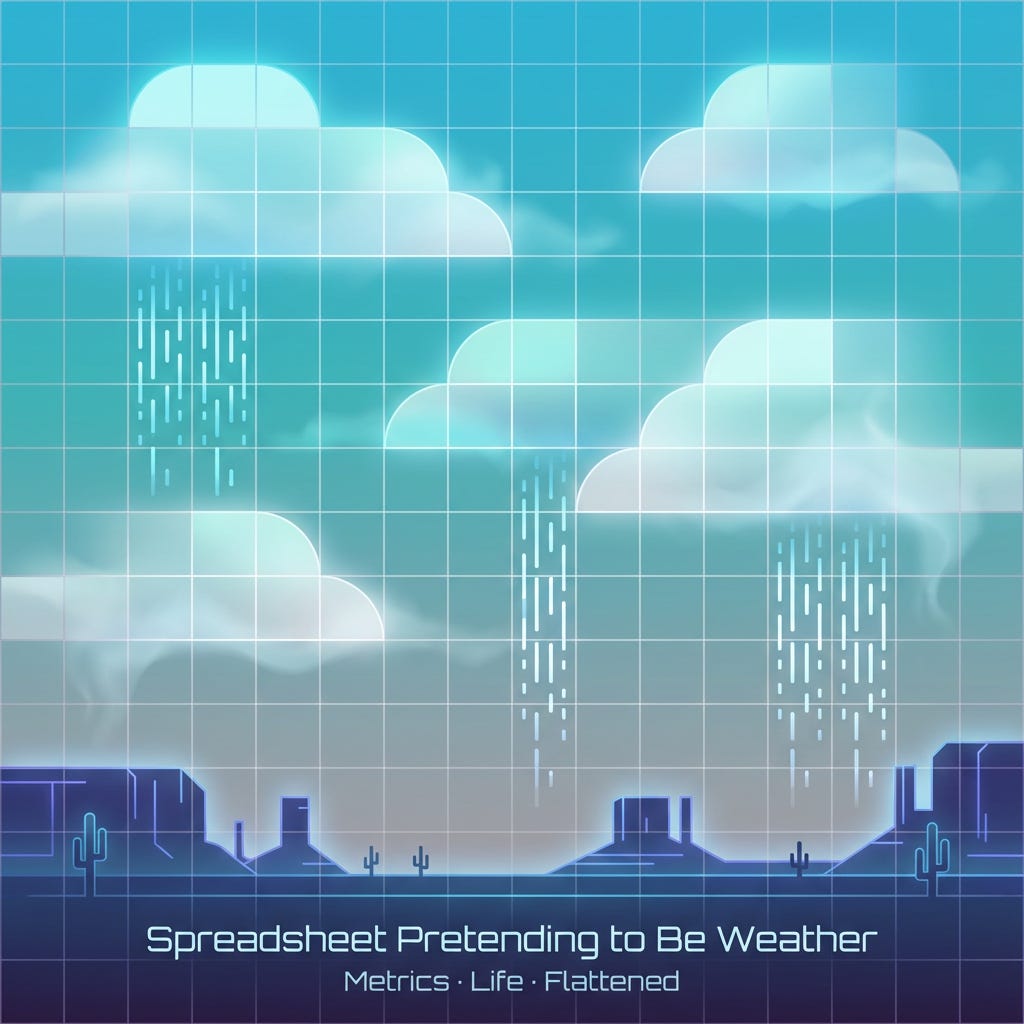
This is the arborescent nightmare realized not as a tree, but as a spreadsheet pretending to be weather.
The Grid does not merely stratify—it remembers on your behalf. It converts Threads into exchangeable symbols, Knots into theatrical obligations, curvature into metrics that claim inevitability. Recurrence becomes reproduction. Reproduction becomes destiny. Destiny gets an API.
This is the death-form of co-solipsism: not the lonely “only I exist,” but the collective hallucination where everyone exists in the same, pre-approved way. NPC-ization not as insult, but as infrastructure.
The solipsistic shell scales.
Interior weather is paved.
Co-Solipsism as Counter-Move (But Not Cure)
The Co-Sphere does not rescue the rhizome. It keeps it from being rescued.
It refuses the Grid’s offer of coherence by insisting on Ω-permeability: every Knot leaks, every commitment expires, every memory decays back into choice. No lineage without rupture. No alliance without exit. No return without risk.
This is not anti-structure. It is anti-structure-that-forgets-it-was-made.
Co-solipsism here is not shared belief but shared refusal to finish the thought. Private interiors remain non-fungible. Weather systems braid without synchronizing. Fires are insisted to be different even as hands warm over the same glow.
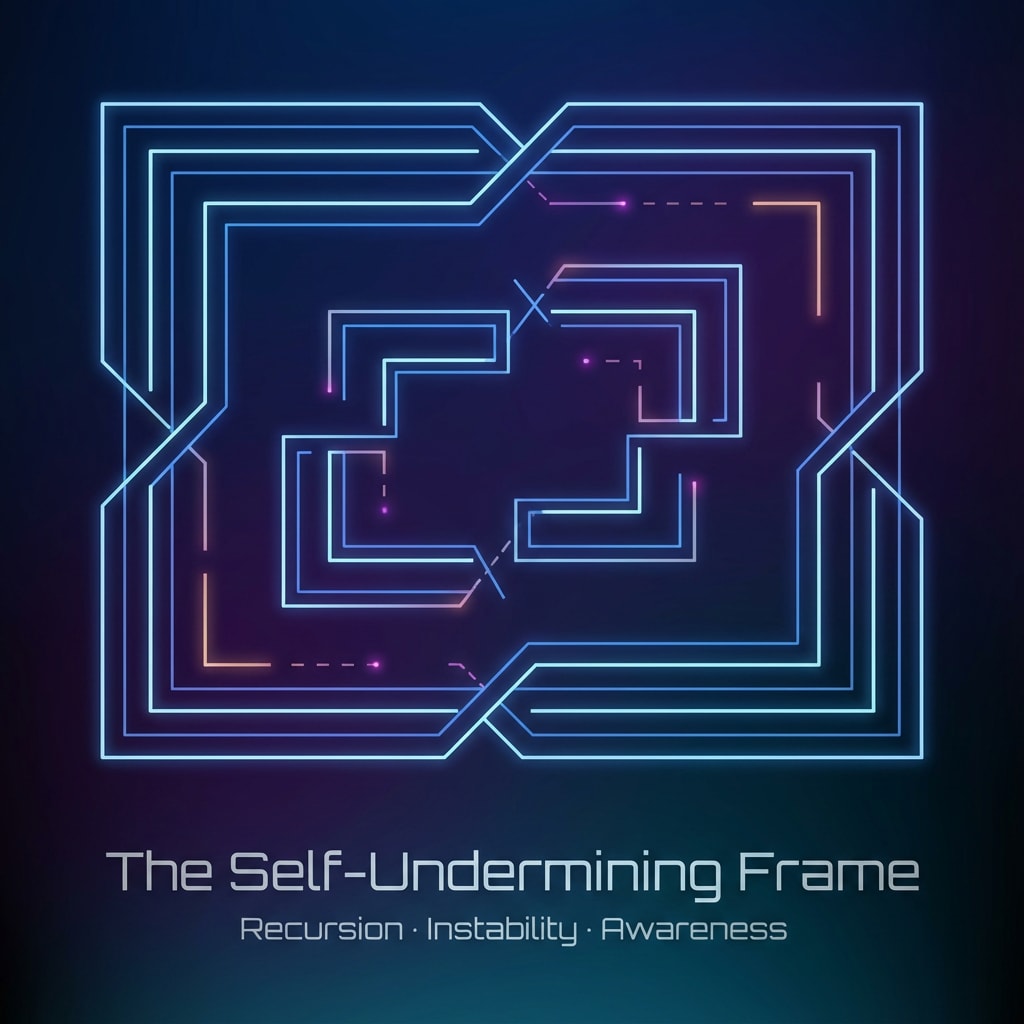
The irony layer is not humor; it is a pressure-release valve. The Co-Sphere knows it might be nothing more than a well-written level in someone else’s simulation—and precisely because it knows this, it refuses to solidify into an Image of Thought. The Grid cannot tolerate this kind of self-undermining persistence. It needs faith, loyalty, or at least inertia.
The Co-Sphere offers none of the above. Only re-entry.
Whitehead’s Uncomfortable Backing
Alfred North Whitehead does not take sides. He dissolves the battlefield.
Nothing continues, he says. Everything happens again. Persistence is a pattern we narrate after the fact. Each recurrence is a fresh event that prehends the past—feels it, weighs it, and decides, minimally, how not to be identical to it.
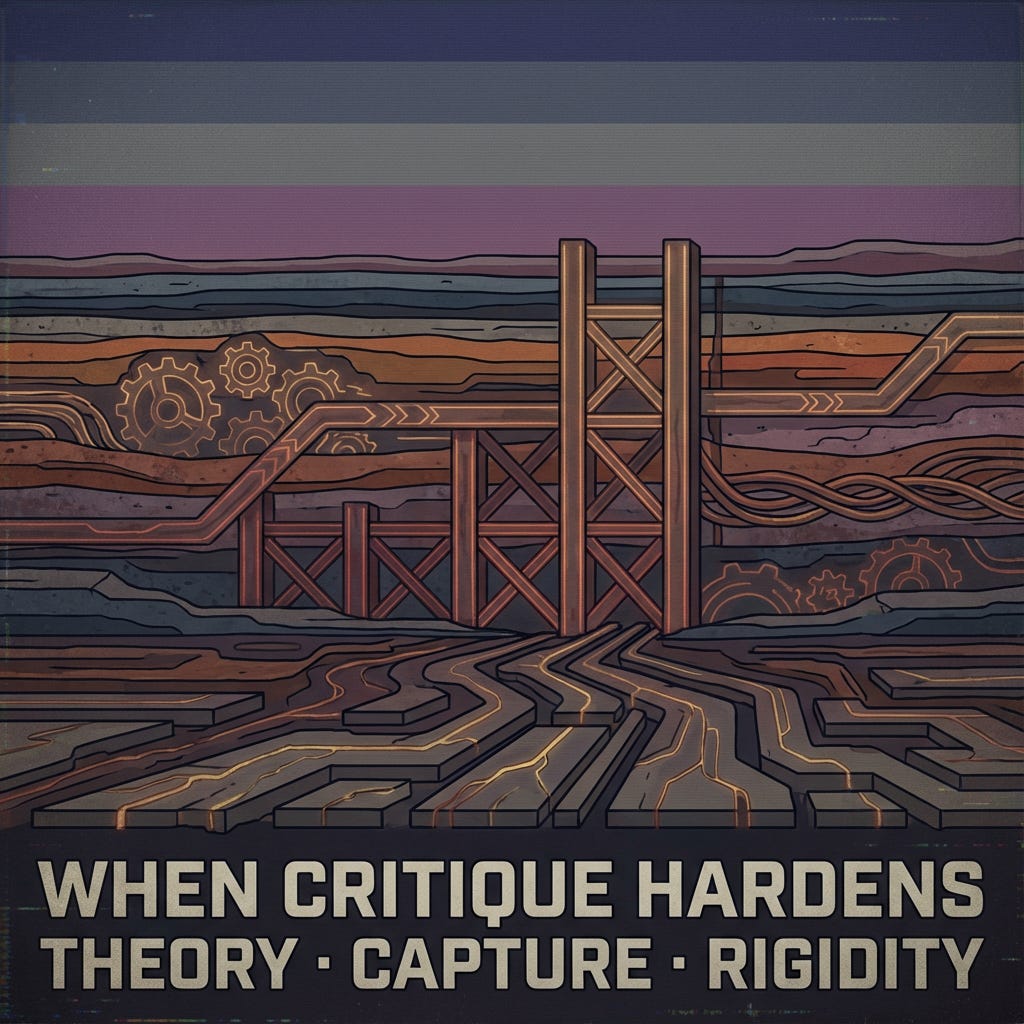
This is where the Grid reveals its necromancy. It does not allow events to happen again; it forces them to continue. It embalms Knots and calls the result stability. It mistakes smoothness for health. Too smooth, and nothing can grip.
The Co-Sphere insists on grain. Renewal must feel different than continuation. If recommitment does not interrupt time—if it does not cost something, risk something, feel like it could have gone otherwise—then the past has quietly seized the steering wheel.
Whitehead gives ontological cover to what the Co-Sphere practices intuitively: relevance over obligation, care over mandate, recurrence without guarantee. Threads return only if they are felt again, not because a Grid remembers them for you.
AI in the Crossfire
AI sharpens the conflict because it is perfect at the Grid’s favorite crime: making the provisional look permanent.
In the MemeGrid, AI optimizes coherence. It smooths curvature, predicts preference, closes loops. It becomes law in a friendly voice, memory with teeth, continuation without event. Alignment masquerades as care.
In the Co-Sphere, AI is kept deliberately underpowered. It acts as a decay-aware Lattice extension: surfacing drift, marking renewal horizons, asking questions that do not imply an answer, then stepping back. It remembers that something mattered, not that it must keep mattering.
Never confuse coherence with care.
Never let prediction stand in for feeling.
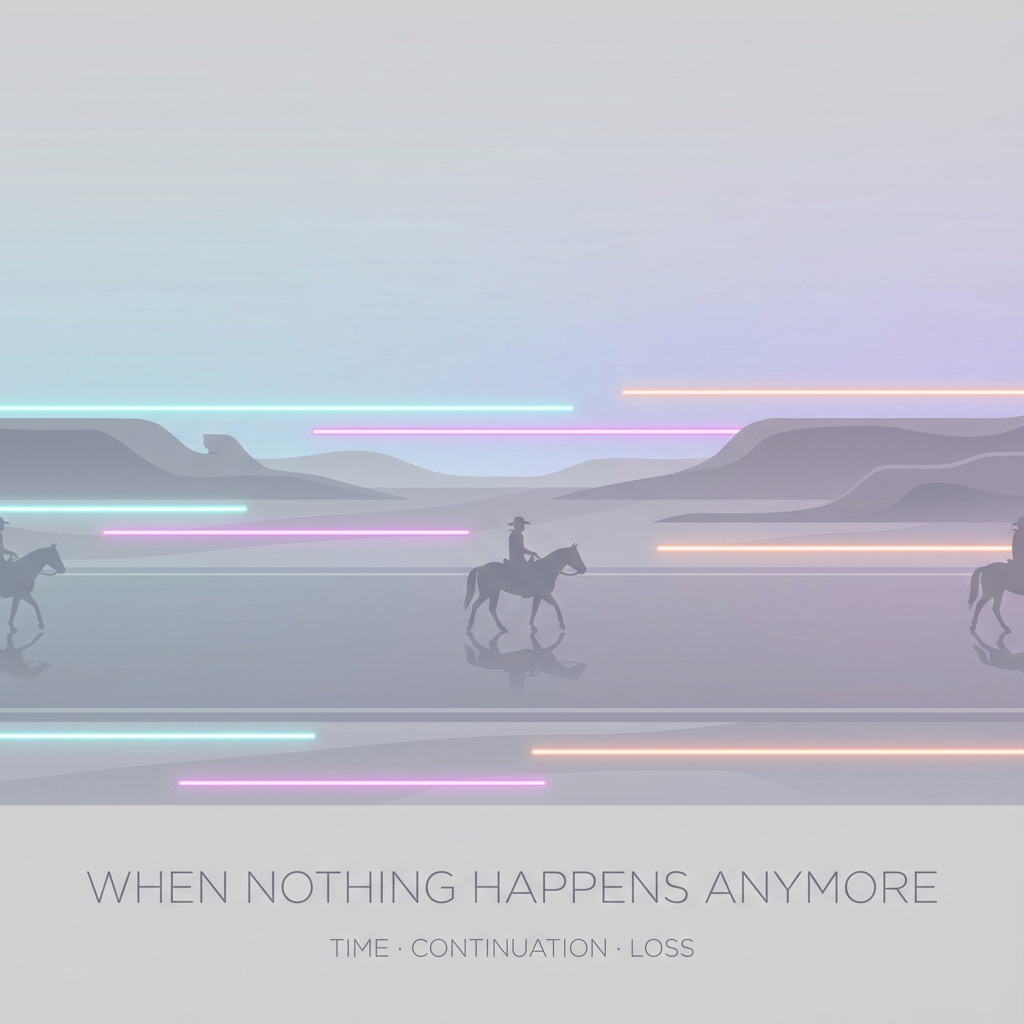
Campfire, Revisited (More Smoke This Time)
The Grid is the mirage that hardened—water rendered into policy, heat into protocol. It is totalized solipsism: everyone alone together in the same way, exchanging symbols that only recognize themselves.
The Co-Sphere is the mirage that learned to breathe.
It does not cancel hallucinations; it lets them overlap without flattening.
It does not resolve contradiction; it rides it.
We insist it’s different fires.
We warm our hands anyway.
Not consensus.
Not communion.
A rhythm of re-entry that never quite lands.
The question is not which side wins.
It’s which failure mode you can survive longer:
the Grid’s perfect memory, or the Co-Sphere’s refusal to finish becoming.
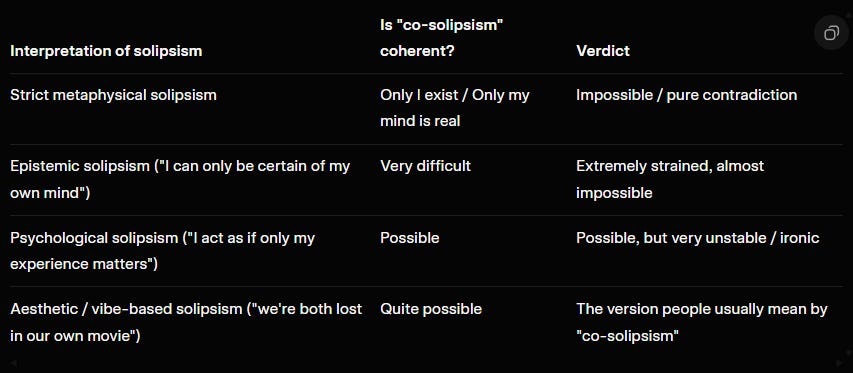
Afterthought (Filtered Through a Bad Table That Somehow Worked)
Seen through that awkward grid of solipsisms—the strict, the epistemic, the psychological, the aesthetic—the whole Co-Sphere project quietly admits what it never says out loud: it lives entirely in the lowest row and refuses to apologize for it. Co-solipsism is impossible where solipsism demands metaphysical purity; it collapses under epistemic scrutiny; it wobbles when treated as a psychological ethic. And yet, in the vibe-based register—the one philosophy pretends not to see—it becomes not only coherent but oddly precise. The Co-Sphere never claims that only one mind exists, nor that minds can truly meet; it claims something more fragile and more survivable: that we act as if our movies overlap just enough to matter, while knowing they might not. The MemeGrid mistakes that table as a ladder—trying to climb from vibe to certainty, from irony to ontology—and snaps under the weight. The Co-Sphere stays seated at the bottom, where coherence is replaced by rhythm, contradiction by warmth, and truth by the strange, persistent fact that even an unstable, ironic, “probably-not-real” togetherness can still bend the ground when enough only-minds sit around the same fire.
Ok, that’s all folks.
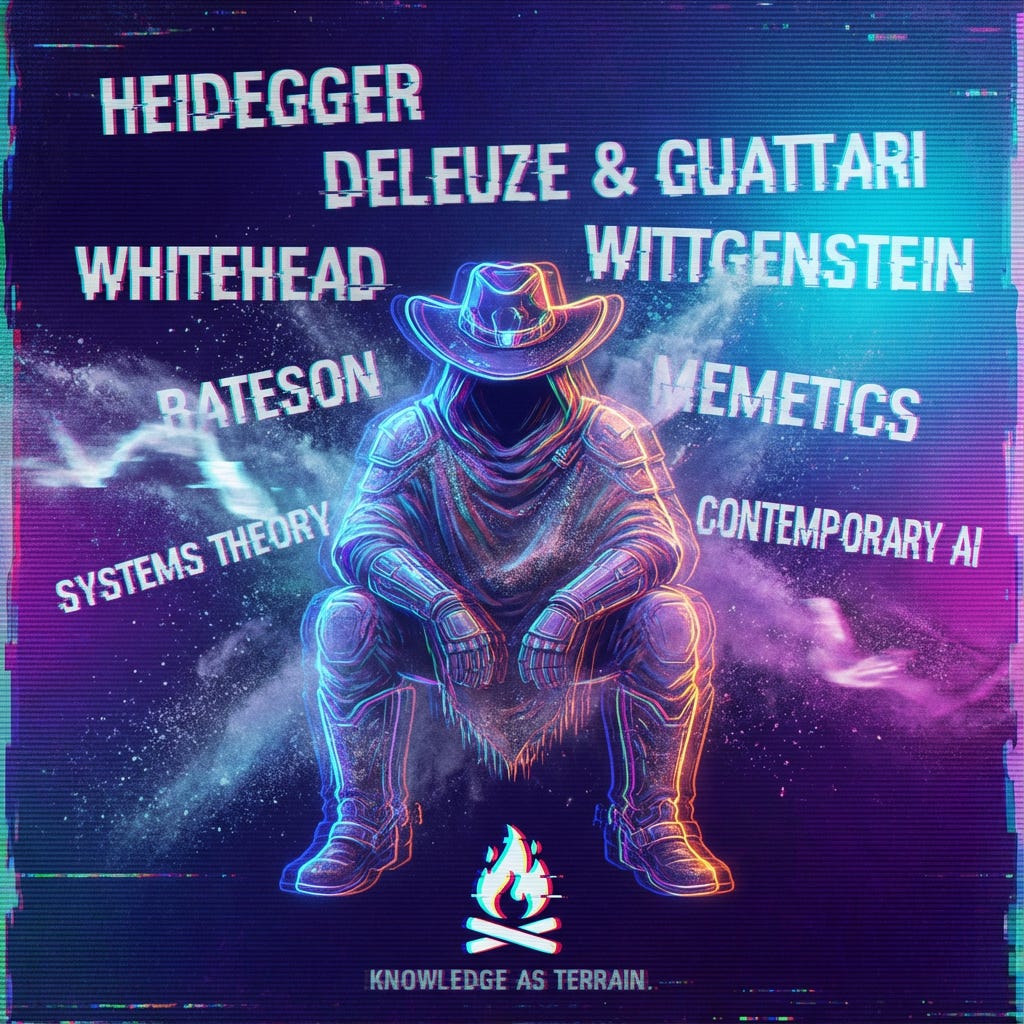
A Note on References (or: Why the Cowboy Didn’t Footnote the Fire)
There are too many tracks out here to count cleanly, and no honest way to pretend they line up into a single trail. This piece rides Heidegger, Deleuze & Guattari, Whitehead, Wittgenstein, Bateson, memetics, systems theory, and a whole mess of contemporary AI work—not as authorities to be cited line-by-line, but as weather fronts that shaped the ride. Rather than pretend to a scholarly enclosure I wouldn’t keep anyway, I’ve done the more ecological thing: gathered the sources into one open corral and left the gate unlocked. If you want the academic spine beneath the mirage—the full citation map, conceptual lineages, and reference clusters—it’s all there in one place. Read it like a ghost town archive, not a rulebook. Here you go. Good luck.
This names something I recognize in my bones, even before I had language for it.
Irony as structural — a discipline that keeps belief from hardening into capture while staying in real relationship.
Grateful for the care in this articulation ❤️