
Before Knowledge: Who Gets to Decide What Counts as Data?
Data, power, AI, and the struggle to keep reality interruptible

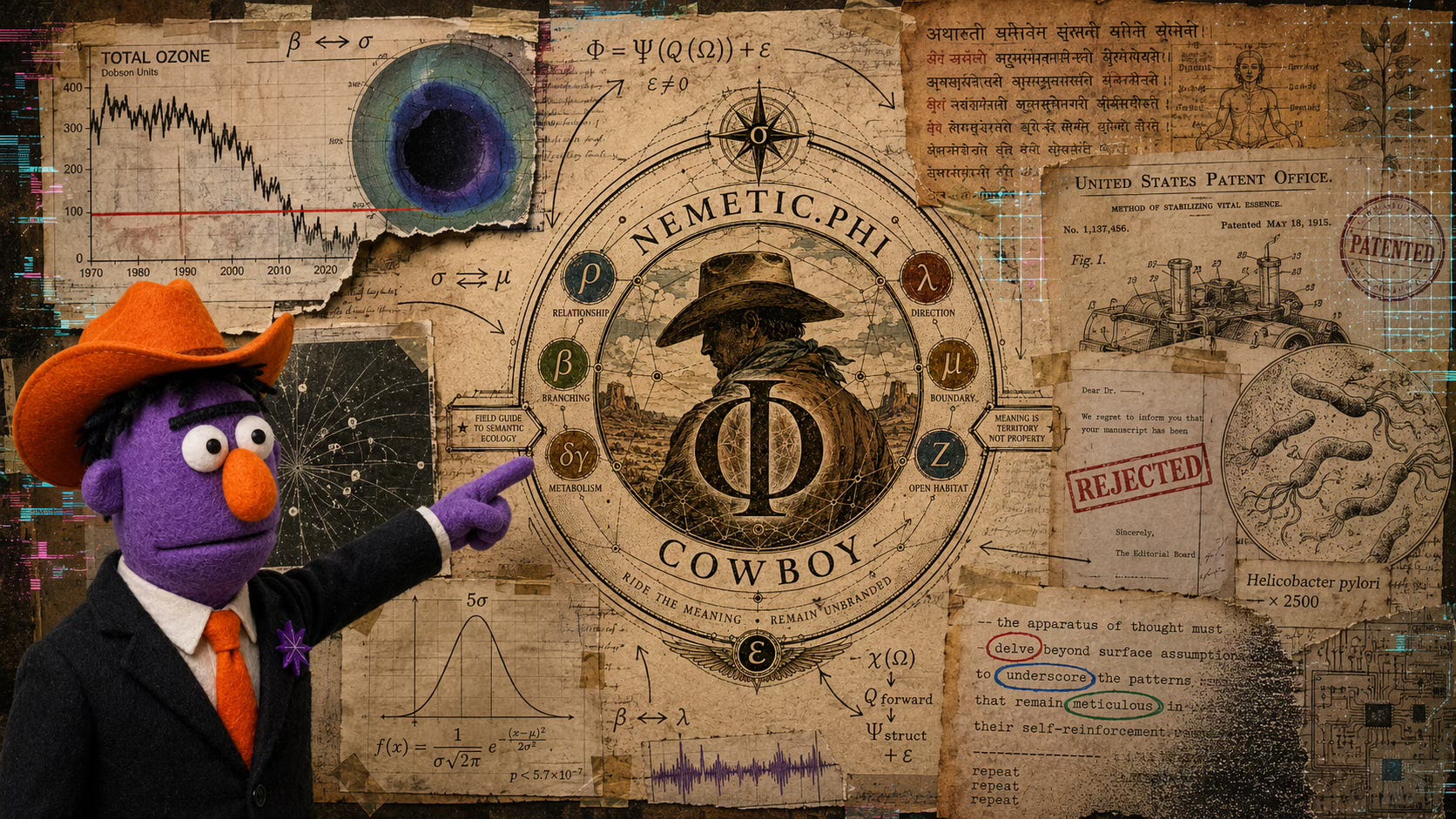
There’s this familiar argument about knowledge that begins too late.
We ask whether a claim is true.
We ask whether the evidence supports it.
We ask whether someone interpreted the evidence correctly.
Increasingly, we ask whether humans know something machines do not, or whether machines now know things no individual human could hold.
But all of those questions arrive after something more basic has already happened.
Something has been admitted as data.
Something else has not.
And if the conditions governing that admission become powerful enough, then what looks downstream like disagreement about truth may actually begin much earlier: with disagreement over what reality is permitted to contribute to the process of knowing.
So the question I keep returning to is no longer only:
What constitutes knowledge?
It is:
What constitutes knowledge when the system producing knowledge also constrains what may count as acceptable data?
I’d been doing some Nemetic.φ readings in effort to resolve this into several distinct problems rather than one large theory of “knowledge.” The useful terrain lies among admissibility, stabilization, corrigibility, recurrence, and whatever remains capable of arriving from outside the current map.
And each distinction suggests something about how knowledge might resist becoming a closed system.
Data Is Already a Cut
The traditional DIKW pyramid gives us a clean progression:
Data → Information → Knowledge → Wisdom
Data appears to be the ground floor: observations waiting to be processed.
Information organizes them.
Knowledge makes them meaningful.
Wisdom tells us what to do.
But Ecological DIKW introduces a small change with large consequences.
It describes data as:
possibility cut into data.
Formally:
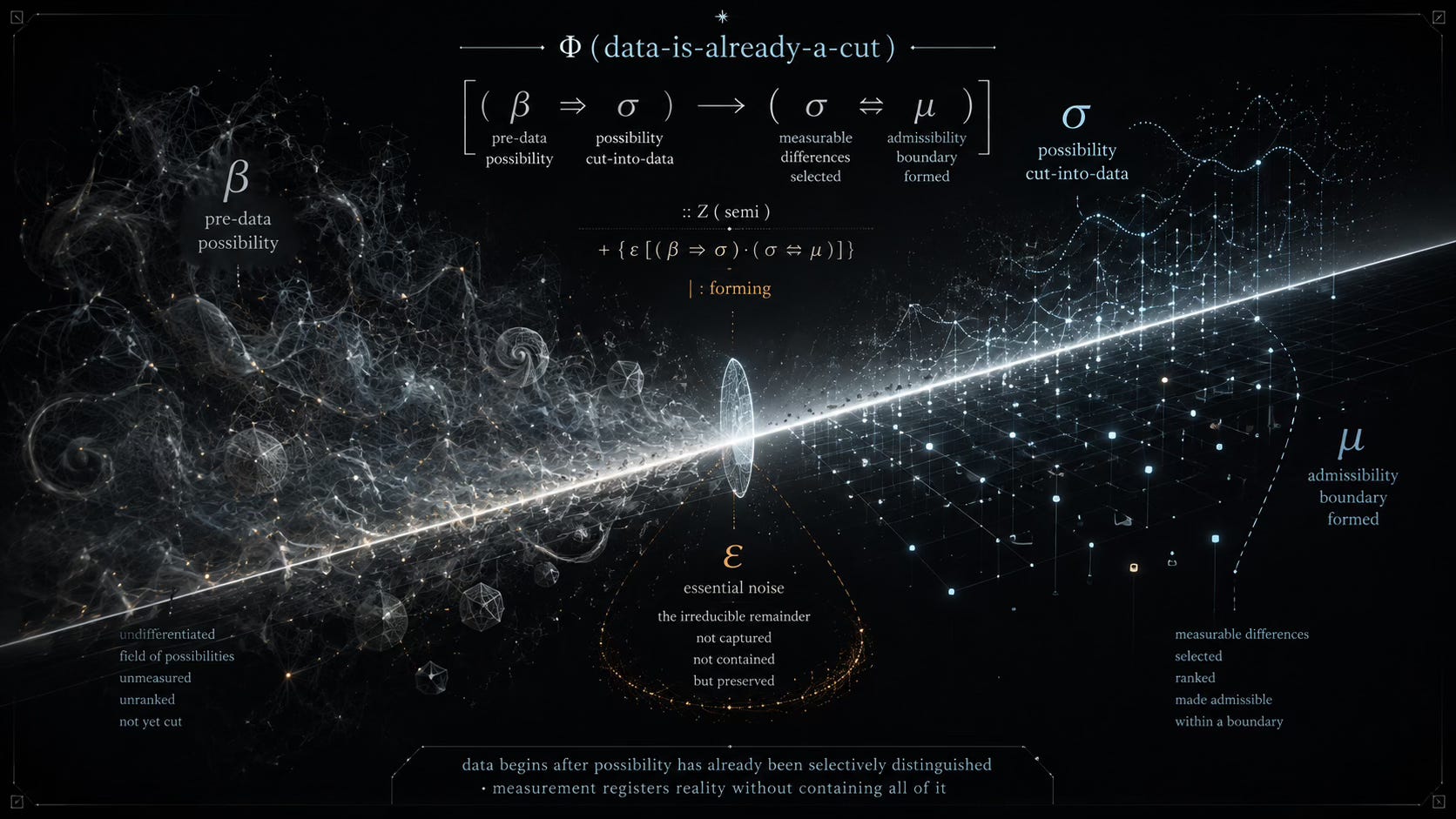
β → σ
Possibility precedes distinction. That shook me a bit.
You see, that means data ain’t quite the beginning.
Before the dataset comes the distinction determining what can enter it.
Before measurement comes a decision about what is measurable.
Before the category comes a boundary.
Reckon this is pretty basic, but it gets weirder.
Run any of these images that NEMA AI made from my pseudo-math (nemetics) in an LLM if you like weirder.
Now look, I ain’t saying data is arbitrary. A thermometer does not negotiate temperature into existence.
The pattern suggests every instrument has a relationship to reality that is partial.
It registers some differences and not others.
The first resistance to epistemic closure, then, is almost embarrassingly simple:
remember the cut.
When presented with data, ask what process turned possibility into this particular dataset.
What got measured?
What ‘didn’t make the cut?’
Which categories organized collection?
Which observations could not enter those categories because they got cut out, whether consciously, or not?
Which populations, experiences, behaviors, or anomalies ended up disappearing during compression?
The Antarctic ozone hole offers a cleaner example than the popular version of its story usually allows.
British Antarctic Survey scientists had been watching Antarctic ozone decline from the ground and published the discovery in 1985. NASA’s Total Ozone Mapping Spectrometer had also been returning unusually low Antarctic readings, and its processing system flagged values below 180 Dobson Units because they fell outside the instrument’s established calibration range. [1]
The familiar version says the software simply threw the discovery away. The historical record is more interesting. The low values were flagged rather than erased, NASA scientists noticed the growing anomaly and investigated it, but the comparison data available to them appeared to contradict the satellite readings. With the retrievals outside the instrument’s expected range, sensor trouble remained a plausible explanation. [2]
So the possibility had arrived at the instrument. What failed was not observation alone but the relationship among the observation, the quality-control boundary, the available validation data, and researchers working across poorly connected records.
That distinction matters because nobody had to be negligent. A defensible rule built around the world previously observed had encountered a world changing beyond its calibration.
β → σ.
The ozone hole was already present in the measurements. The difficult question was whether the existing cut could recognize the measurements as evidence of atmospheric reality rather than evidence of instrument failure.
This ain’t an argument for distrusting data.
It is an argument against confusing the result of observation with the total field of the observable.
The distinction can be written:
data begins after possibility has already been selectively distinguished.
That sentence leaves something outside the dataset without pretending we already know what the outside contains.
I reckon that sets the footing for the next step.
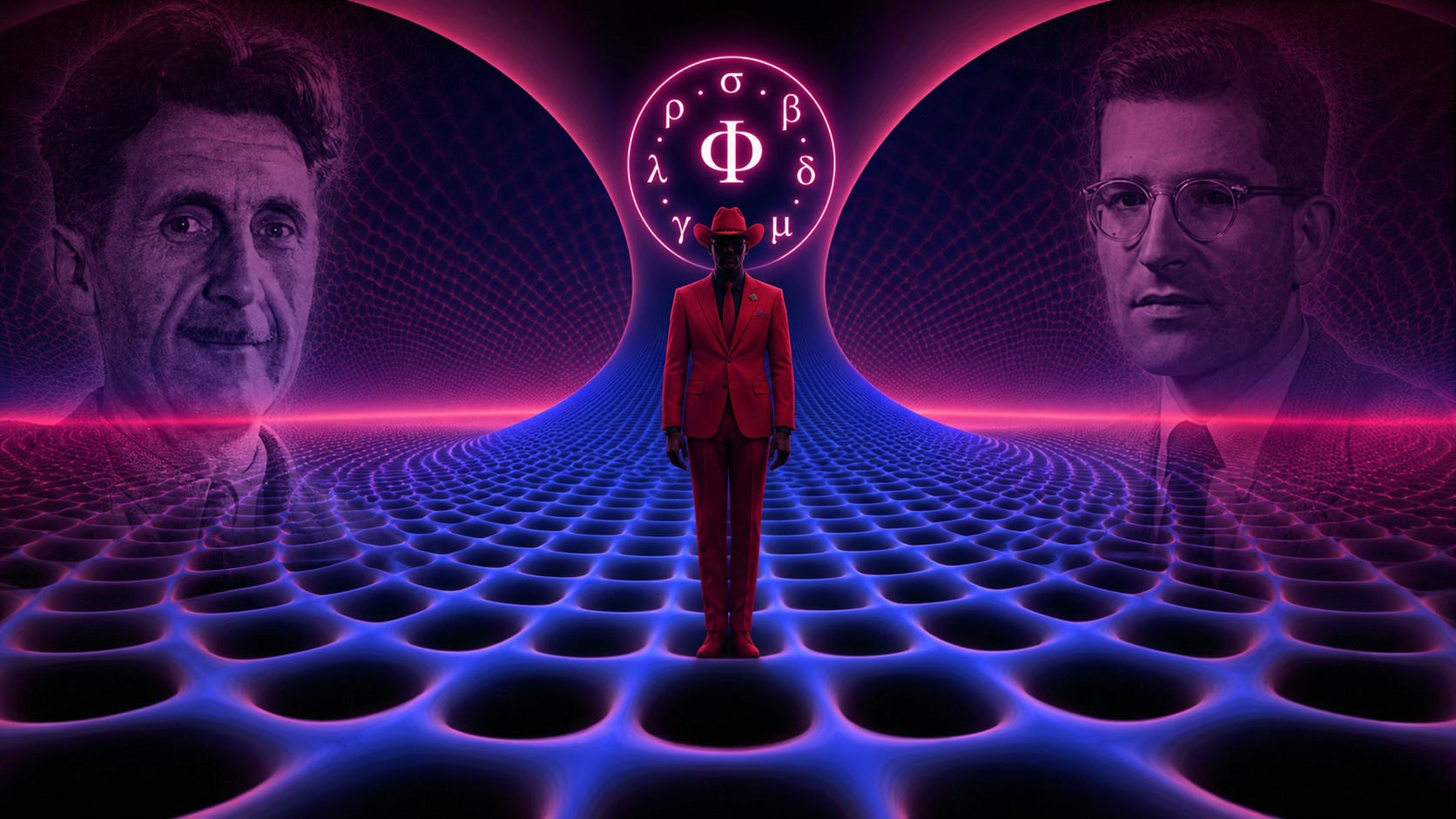
Infrastructural Admissibility - Chomsky-Orwell
The crude version of censorship says:
You may not say this.
A more durable version says:
This is not a legitimate distinction.
More durable still:
There is nothing here to distinguish.
By that point suppression no longer needs to operate primarily against statements.
It operates against the conditions from which statements could emerge.
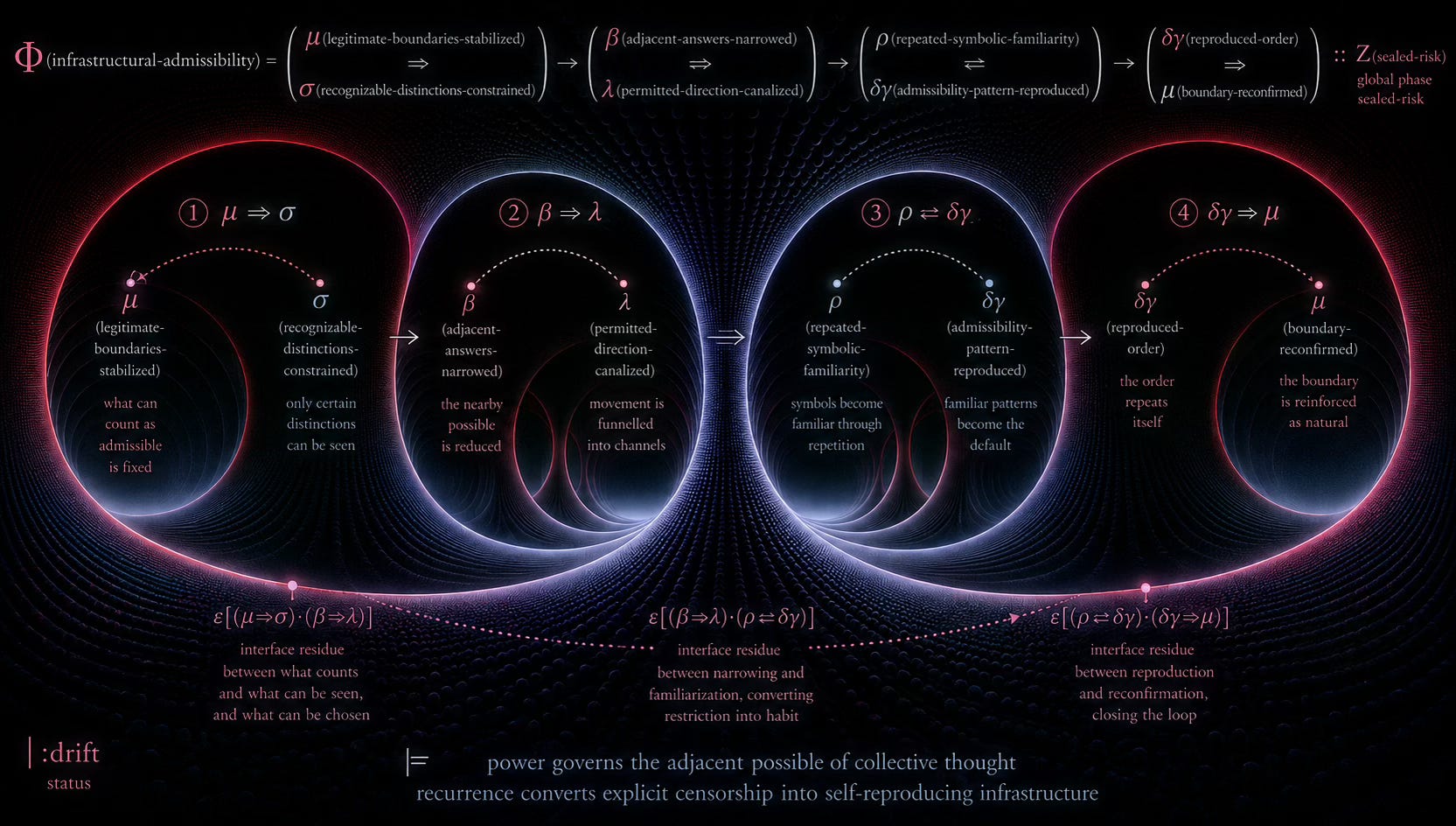
I’d been writing this Chomsky-Orwell synthesis that revealed something notable, at least to me. It showed a recurrent sequence:
μ → σ → β → λ → ρ → δγ → μ
Boundaries stabilize what counts as legitimate. (μ)
Orwell’s Newspeak is the clearest formalization of this operator. The entire project of Newspeak was boundary-setting: the progressive reduction of vocabulary until certain concepts simply fell outside the space of possible utterance. As Syme explains, the aim was not merely to provide words for orthodoxy but “to make all other modes of thought impossible.” [3]
Those boundaries determine which distinctions are recognizable. (μ → σ)
Once the boundary is set, certain distinctions become invisible or unintelligible. Chomsky shows it in the narrowing of the spectrum of acceptable opinion: lively debate is permitted only inside the pre-filtered range, while positions outside that range are rendered non-serious, extreme, or simply unrecognizable as contributions to public reason.
Available distinctions shape which conceptual branches remain reachable. (σ → β)
This is the branching logic of conceptual possibility. Orwell’s Newspeak deliberately prunes branches so that heretical thought becomes “literally unthinkable.”
Chomsky’s model describes how media systems, by consistently amplifying some distinctions and starving others, make entire lines of inquiry practically unreachable for most participants. [7]
Available branches constrain possible directions. (β → λ)
Directionality follows from reachability. Once certain conceptual branches are unavailable, the range of coherent trajectories shrinks. Orwell’s doublethink and the Party’s inversion of values illustrate forced directionality: only certain paths remain navigable.
Chomsky’s analysis of how consent is manufactured shows the same constraint operating at scale when he observes how public debate gets steered along pre-cleared channels while alternative directions are left without institutional oxygen. [4] [8]
Repeated directions become familiar. (λ → ρ)
Repetition produces familiarity and, eventually, naturalness. Orwell understood that the continuous circulation of approved slogans and inverted valuations would eventually make the Party’s frame feel ordinary.
Chomsky’s work on the propaganda model emphasizes the cumulative effect of consistent framing: what gets repeated across major outlets takes on the appearance of common sense. [4] [5]
Familiar representations are metabolized into ordinary reality. (ρ → δγ)
Here the loop moves from representation into lived ontology. Familiar frames cease to register as frames and become the background against which reality is perceived. Orwell’s final command—“reject the evidence of your eyes and ears”—captures the endpoint of this metabolization. [9]
Chomsky’s claim that the media’s primary function is to inculcate the values and codes that integrate individuals into the existing institutional order describes the same process in sociological terms: the manufactured becomes the ordinary. [4] [5]
That ordinary reality then appears to confirm the boundaries with which we began. (δγ → μ)
The loop closes. Once the manufactured frame has been metabolized into ordinary reality, it supplies its own confirmation. Apparent consensus and the absence of serious alternatives are read as evidence that the original boundaries were correct.
Both Orwell and Chomsky saw this recursive self-validation as the system’s most powerful stabilizing mechanism. It no longer requires constant active policing; the infrastructure of admissibility does the work. [3] [4] [8]
The result ain’t exactly censorship.
It is infrastructural admissibility.
Power becomes more durable when it no longer needs to prohibit every unwanted conclusion because the pathways toward those conclusions have become difficult to enter.
The corresponding resistance is not simply “say forbidden things.”
It is to examine the architecture of admissibility itself.
Ask:
Who sets the categories?
Which distinctions are cheap to make here?
Which require extraordinary effort?
Which questions receive immediate institutional recognition?
Which sound incoherent before they can even be investigated?
In 1995, two researchers at the University of Mississippi were granted a U.S. patent for the use of turmeric in wound healing. India successfully challenged it two years later by producing prior art showing that the practice had long been known, including documentation in Sanskrit sources and a 1953 scientific paper. [10]
The important part is how the knowledge had initially remained difficult for the patent system to see. Prior art searches depend on written or visual documentation that patent examiners can reasonably access. Rare material held in unfamiliar languages, classification systems, or libraries can exist perfectly well and still remain functionally absent from the search.
The category did not need to be deliberately rigged against traditional knowledge. It was enough for admissibility to be organized around what the existing infrastructure could retrieve.
India’s later response makes the problem visible from the other direction. The Traditional Knowledge Digital Library began translating and classifying material from Ayurveda, Siddha, Unani, Yoga, and related traditions into forms that international patent examiners could search as prior art. [11]
The knowledge did not suddenly become true when the database could retrieve it.
It became legible to the boundary.
That is not quite a victory over the boundary.
It is a victory inside it.
Worth noticing which one actually happened.
Ask:
Which boundaries have become so ordinary that they no longer appear to be boundaries?
This does not tell us that excluded claims are true.
Exclusion ain’t evidence.
It makes the infrastructure available for inspection.
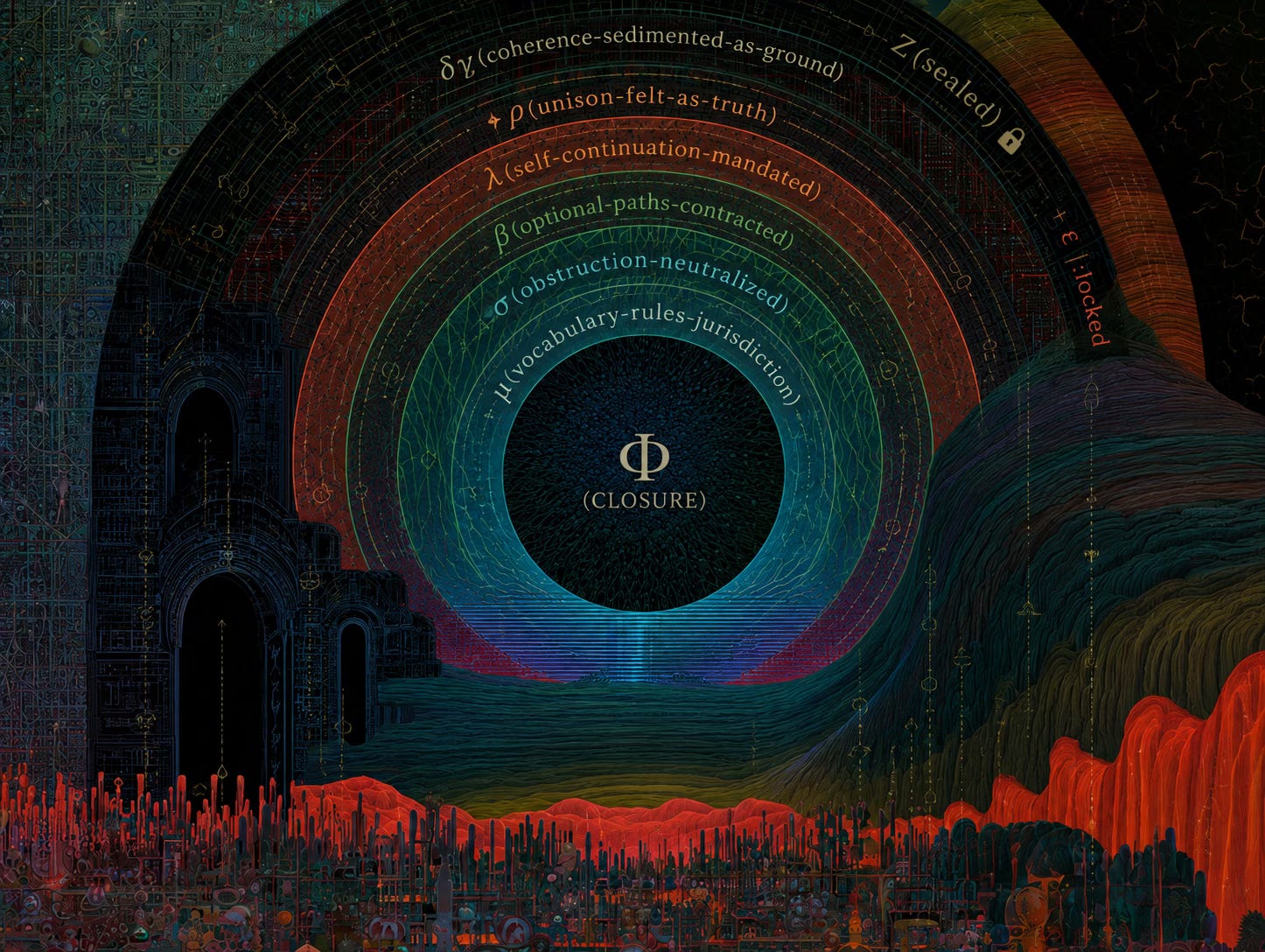
CLOSURE
The CLOSURE diagnostic backronym that I shared earlier gets useful at this point.
C — Coherence becomes ground.
A framework stops saying this account hangs together and begins behaving as though whatever does not hang together inside it is therefore less real. Historically contingent categories acquire the weight of ontology.
L — Legibility consumes obstruction.
An anomaly no longer gets to remain anomalous. The system translates it immediately into something already recognizable: error, ignorance, pathology, bias, hostility, noise.
This is subtler than rejecting evidence.
The evidence is accepted only after being converted into something that cannot threaten the frame.
O — Optional paths collapse.
Explanations may proliferate while genuinely different inferential routes disappear.
Quantity of interpretation becomes a poor proxy for openness.
S — Self-continuation becomes mandate.
Once the framework can explain both confirmation and contradiction, preserving the framework begins to look indistinguishable from following the evidence.
Success confirms it.
Failure demonstrates why it remains necessary.
Criticism proves how deeply the problem runs.
Exit becomes evidence that the departing person never understood it.
At that point correction has become remarkably difficult because almost every outcome points in the same direction.
U — Unison is experienced as truth.
Closure also has an aesthetic dimension.
Repeated vocabulary, metaphors, rhythms, citations, and explanatory forms can make an interpretation feel complete before its claims have earned completeness.
Coherence produces pleasure.
Familiarity produces fluency.
Neither is evidence.
A framework can become beautiful enough that discord begins to sound like incompetence.
R — Rules determine reality’s jurisdiction.
The boundary no longer merely distinguishes stronger evidence from weaker evidence.
It determines what is permitted to arrive as evidence, who is recognizable as a competent speaker, and how challenges from outside the framework must be interpreted.
The gate has become a customs office for reality.
And then comes the final movement:
E — ε collapses while drift expands.
This is the strange part.
From inside a closing system, things can feel increasingly frictionless.
Contradictions disappear.
Vocabulary stabilizes.
Interpretations converge.
More of the world becomes explainable using fewer conceptual moves.
ε → 0.
But decreasing internal friction does not necessarily mean increasing contact with reality.
The system may simply be getting better at translating whatever arrives into itself.
So ε is not the accumulated distance between framework and world.
Here it names something closer to the remaining imperfection in the translation—the residue that still refuses complete assimilation.
The grain of sand the framework cannot quite digest.
Closure eliminates that friction precisely while its unregistered distance from changing conditions may be increasing.
That gives us a disturbing possibility:
a knowledge system can become more internally coherent as it becomes less corrigible.
The warning sign is therefore not coherence itself.
It is coherence without remainder.
Ask:
Can this framework encounter something it cannot immediately explain?
Can a contradiction remain a contradiction long enough to alter the categories receiving it?
Does disagreement still have somewhere to stand outside the framework’s explanation of disagreement?
What observation would force not merely a different answer, but a different vocabulary for asking the question?
If the answer is nothing, we have crossed an important boundary.
The map can no longer lose.
And a map that cannot lose an argument with the territory has stopped functioning as a map.
The Epistemic Immune System
There is a more difficult stage of closure.
A sufficiently stabilized knowledge system can begin determining what may count as evidence against itself.
Its existing categories recognize compatible observations.
Anomalies become illegible.
Illegibility reduces available revision paths.
The resulting lack of contradiction appears to confirm the original categories.
Robin Warren began noticing curved bacteria in gastric biopsy specimens in 1979. Barry Marshall joined the work, and together they pursued a possibility that sat awkwardly against prevailing medical assumptions about gastric disease: bacteria appeared to be living in an environment widely regarded as too hostile for persistent colonization, while ulcers were commonly understood through excess acid, stress, diet, and related explanations. Their early reports eventually appeared in The Lancet in 1983 and 1984. [12]
Marshall later made the confrontation unusually literal. In 1984 he swallowed a culture containing the bacteria. Within days he became ill; an endoscopy ten days later showed H. pylori and inflammatory changes in his stomach lining. He developed gastritis, though not an ulcer. [13]
The episode is often told as one heroic scientist defeating a stubborn establishment. That version is too neat for the point here.
What matters is that an observation can arrive before a field has an easy conceptual place to put it. Warren could see the organisms before medicine had stabilized the relationship among those organisms, gastritis, and peptic-ulcer disease.
An anomaly does not enter an empty room.
It enters a room already furnished with explanations.
Resistance begins by making sure the furniture can still be moved.
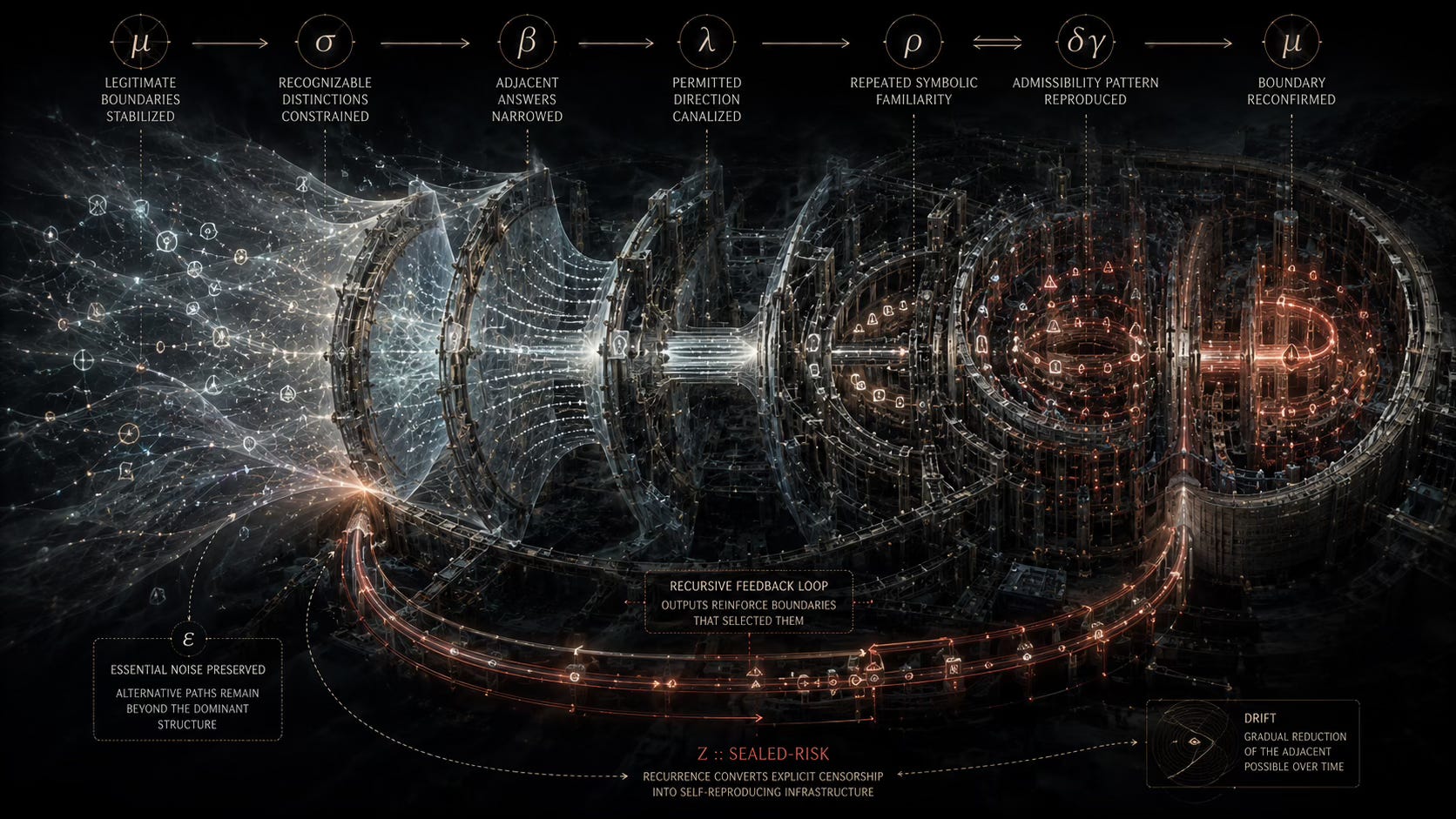
Formally, the loop looks something like:
μ → σ → β → λ ⇄ δγ
The system acquires an epistemic immune system.
This is not always pathological.
Knowledge systems need defenses.
A scientific journal that treats every unsupported assertion as equivalent to controlled evidence has not become open-minded. It has stopped doing useful discrimination.
A newsroom needs verification standards.
A court needs admissibility rules.
A machine-learning pipeline needs criteria for data quality.
Boundaries ain’t the enemy.
The danger appears when those boundaries become self-validating.
Contradictory information no longer needs to be disproved if it can first be classified as unserious, illegible, irrelevant, anecdotal, unprofessional, unsafe, unscientific, or outside scope.
Sometimes those classifications are warranted.
Sometimes they are precisely where the closure hides.
So resistance here requires a harder question than “What evidence supports this?”
Ask:
What would this system recognize as evidence that its own evidentiary categories need revision?
That question reaches beneath disagreement over conclusions.
A system capable of answering it still has a correction path.
A system structurally incapable of answering it may be doing something other than inquiry, however sophisticated its reasoning remains.
Here’s what my reasoning looks like as a nemetic.phi:
Φ(infrastructural-admissibility) =
[
(
μ(legitimate-boundaries-stabilized)
⇒
σ(recognizable-distinctions-constrained)
)
→
(
β(adjacent-answers-narrowed)
⇒
λ(permitted-direction-canalized)
)
→
(
ρ(repeated-symbolic-familiarity)
⇄
δγ(admissibility-pattern-reproduced)
)
→
(
δγ(reproduced-order)
⇒
μ(boundary-reconfirmed)
)
]
:: Z(sealed-risk)

{
ε[(μ⇒σ)·(β⇒λ)],
ε[(β⇒λ)·(ρ⇄δγ)],
ε[(ρ⇄δγ)·(δγ⇒μ)]
}
| :drift
⊨
power governs the adjacent possible of collective thought
· recurrence converts explicit censorship into self-reproducing infrastructure
Corrigible Boundaries
This is where critique has to become constructive.
If every boundary is treated as domination, knowledge dissolves.
If every exclusion becomes suspicious merely because something was excluded, discernment becomes impossible.
We need standards.
We need distinctions between stronger and weaker evidence.
We need methods.
We need categories.
We need institutions capable of stabilizing what repeated inquiry has given us reason to trust.
The question is whether those boundaries can themselves be revised.
This gives us a different configuration:
σ ⇄ μ
Evidence distinctions remain coupled to revisable admissibility boundaries.
And:
β ⇄ λ
Alternative categories remain possible without making inquiry directionless.
This is what I mean by corrigible boundaries.
Not boundarylessness.
Not permanent skepticism.
Not the flattening of expertise into “everyone has their own truth.”
A corrigible boundary can say:
No, this does not currently meet our evidentiary standard.
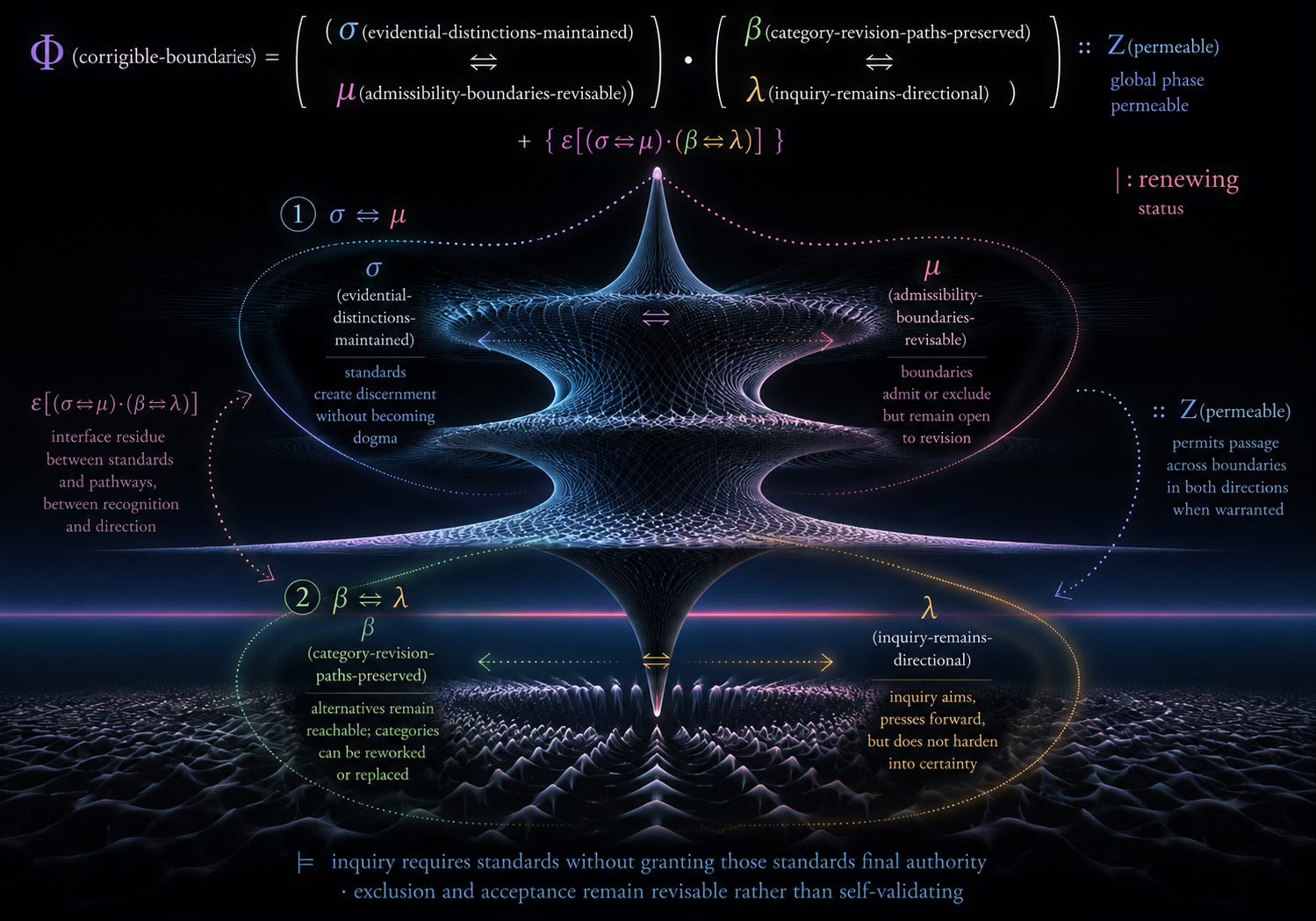
But it must also remain capable of answering:
Under what conditions would the standard itself change?
That distinction matters.
It lets us preserve rigor without granting rigor’s present instruments final authority.
It also gives us a practical form of resistance that don’t require rejecting institutions wholesale.
Look for correction channels.
Can categories be challenged?
Can anomalies accumulate?
Can methods change?
Can excluded observations eventually alter what counts as admissible?
Particle physics offers one useful example because its evidentiary boundary has a history rather than a timeless justification.
Five sigma is now the conventional threshold for claiming a discovery in particle physics: roughly a probability of (3 \times 10^{-7}) of observing an effect at least that extreme if the relevant null model is correct. But the convention solidified comparatively recently, and part of its rationale comes from experience with apparently interesting three- and four-sigma effects that disappeared as more data arrived. [14]
One of the failure mechanisms has a name: the look-elsewhere effect. Search across enough possible masses, energies, channels, or other locations and the chance of finding an apparently unusual fluctuation somewhere rises. The local surprise therefore cannot automatically be treated as though that particular location were the only place anyone looked. [15]
Five sigma is not a magic boundary, and physicists themselves debate whether a single threshold is too crude. What matters here is the structure of the response: identifiable ways of fooling oneself become reasons to modify how evidence is evaluated. Blinding, global rather than merely local significance, independent data, systematic-error analysis, and stricter discovery conventions are different attempts to make the boundary answerable to known modes of failure.
σ ⇄ μ.
The standard did not become infallible.
It became capable of naming some of the ways it could be wrong.
That is closer to corrigibility than simply saying:
we trust ourselves more now.
The IF-Prime working material I drummed up last year repeatedly treats this capacity for revision as a viability condition rather than an optional virtue: stabilization becomes brittle when uncertainty and alternative pathways are driven out.
The later IF-Prime ↔ Memetic Ecology interface makes the same constraint reflexive: the framework itself must remain easier to revise than to defend.
That may be the first positive definition emerging here:
inquiry requires standards without granting those standards final authority.
Human–Machine Admissibility Recursion
Now the machines enter.
AI systems don’t encounter the world in the same way embodied humans do.
They encounter constructed informational environments.
Datasets.
Documents.
Labels.
Images.
Metadata.
Preference signals.
Retrieval systems.
Evaluation criteria.
Institutional policies.
Human prompts.
Every one of these already contains decisions about admissibility.
What counts as relevant?
What counts as authoritative?
What gets excluded?
What gets weighted?
What becomes retrievable?
What becomes machine-readable at all?
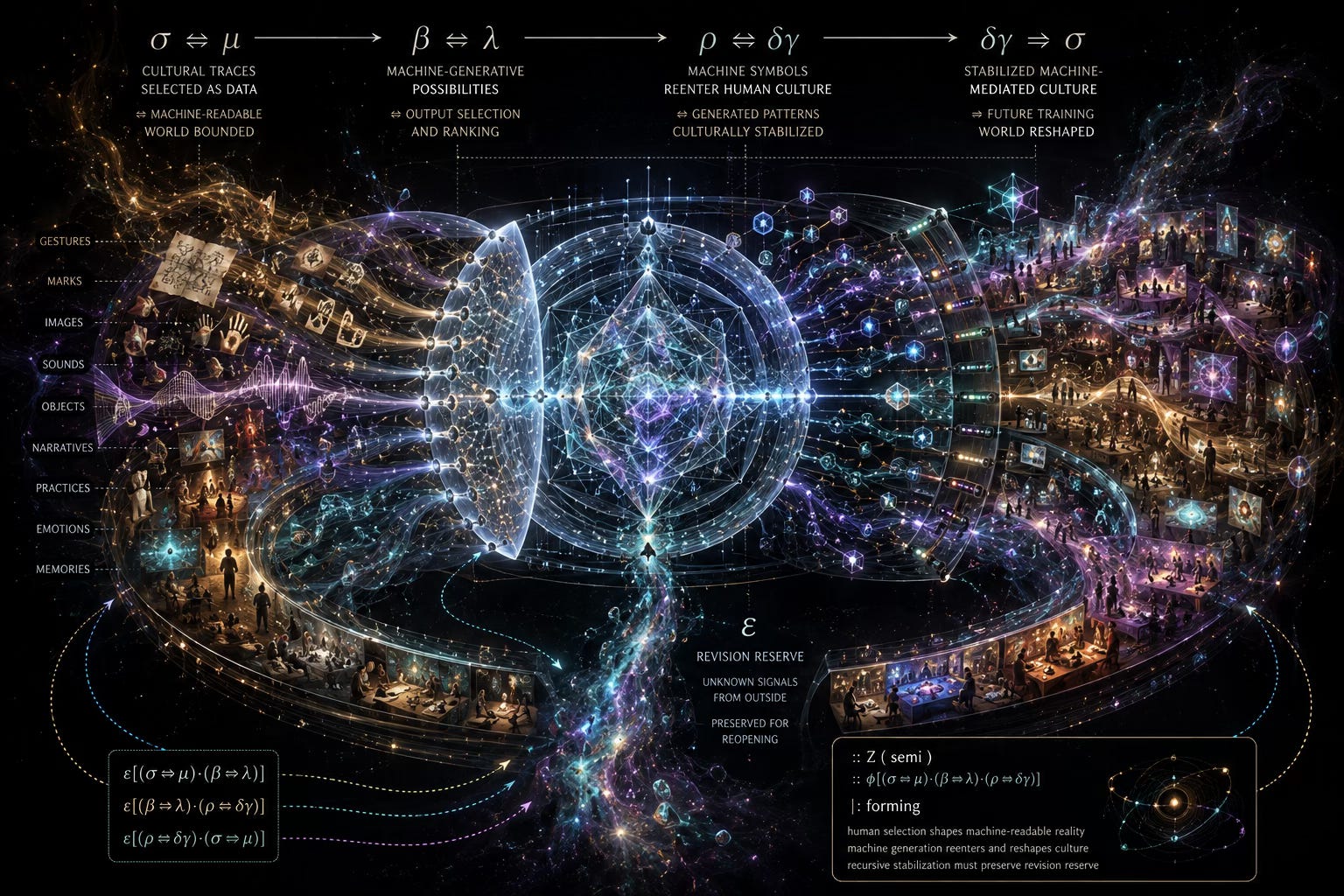
Human selection therefore helps bound the machine-readable world.
The machine then generates new possibilities inside and across those boundaries.
Those outputs are selected, ranked, filtered, published, repeated, rejected, quoted, summarized, and incorporated into human culture. (This very work is such an output.)
And some portion of that machine-mediated culture eventually becomes material for future machines.
The topology becomes recursive:
human culture → institutional selection → machine-readable world → machine generation → human culture → future machine-readable world
This is why the φ lens becomes interesting here.
Not because φ proves some transcendent human-machine intelligence has appeared.
It don’t.
The lens becomes useful because the output repeatedly re-enters the conditions of subsequent production.
The machine is no longer simply retrieving from an archive.
It participates in cultural recurrence.
One signature has appeared in the language of academic publishing.
A large-scale study comparing scholarly writing before and after ChatGPT’s public release found substantial increases in a cluster of words associated with LLM-generated prose, including delve, underscore, meticulous, and related terms. In mathematics publications, for example, the share containing forms of delve rose from 0.02 percent in 2022 to 0.72 percent in 2024. The researchers also found much stronger post-2022 co-occurrence among several of these terms. [16]
The authors are careful about causation. Word-frequency changes do not prove that a particular sentence was written by a language model, and they explicitly describe these as LLM-associated terms, not forensic markers of machine authorship.
That qualification makes the example more useful, not less.
The claim does not need to be that machines secretly wrote the literature.
It is enough that machine-associated stylistic tendencies can enter human writing, become part of the published record, and thereby become available to future retrieval systems and potentially future training corpora.
Not new findings.
Not new topics.
A detectable shift in the texture of expression.
The recursion is therefore plausible without pretending we can already measure its full strength:
machine-generated preference → human uptake → cultural record → future machine-readable material
Nobody has to do anything wrong for that loop to form.
And the research does not yet establish how much later models are being trained on those altered texts.
That remains a separate empirical question.
What we can already see is the first re-entry.
That gives resistance a different meaning.
We need to examine not only individual machine outputs but the loop that produces their successors.
Ask:
What human material enters?
What gets excluded?
Which machine outputs receive distribution?
Which are buried by ranking systems?
Which generated patterns become culturally familiar?
Which familiar patterns then appear disproportionately in future human production?
Are machines increasing the reachable space of distinctions?
Or are human and machine systems recursively training one another toward a narrower basin of highly probable expression?
We don’t yet know the answer in any general sense.
But that is the right scale of question.
The danger ain’t merely that a machine sometimes says something false.
A harder problem is a machine that produces perfectly coherent answers from an increasingly impoverished admissibility structure.
Nothing needs to malfunction.
Nothing needs to hallucinate.
The machine can accurately represent the world it was permitted to receive.
The trouble is that this world may no longer be large enough.
And because of this, resistance requires maintaining a revision reserve inside the recursion: routes by which unfamiliar human experience, minority observations, new categories, contradictory evidence, and genuinely novel distinctions can still alter what becomes machine-readable and culturally repeatable.
Otherwise recursion becomes amplification.
And amplification can look remarkably like confirmation from inside the loop.
Knowledge Requires an Outside
This may be the deepest distinction in the whole reading. And I applaud you for making it this far.
A knowledge ecology cannot merely circulate meaning effectively.
It needs some capacity for reality to interrupt the circulation.
Not an absolute outside.
Not a pristine realm untouched by language, institutions, instruments, bodies, or mediation.
Something more operational:
a correction path from what the present representation does not yet contain.
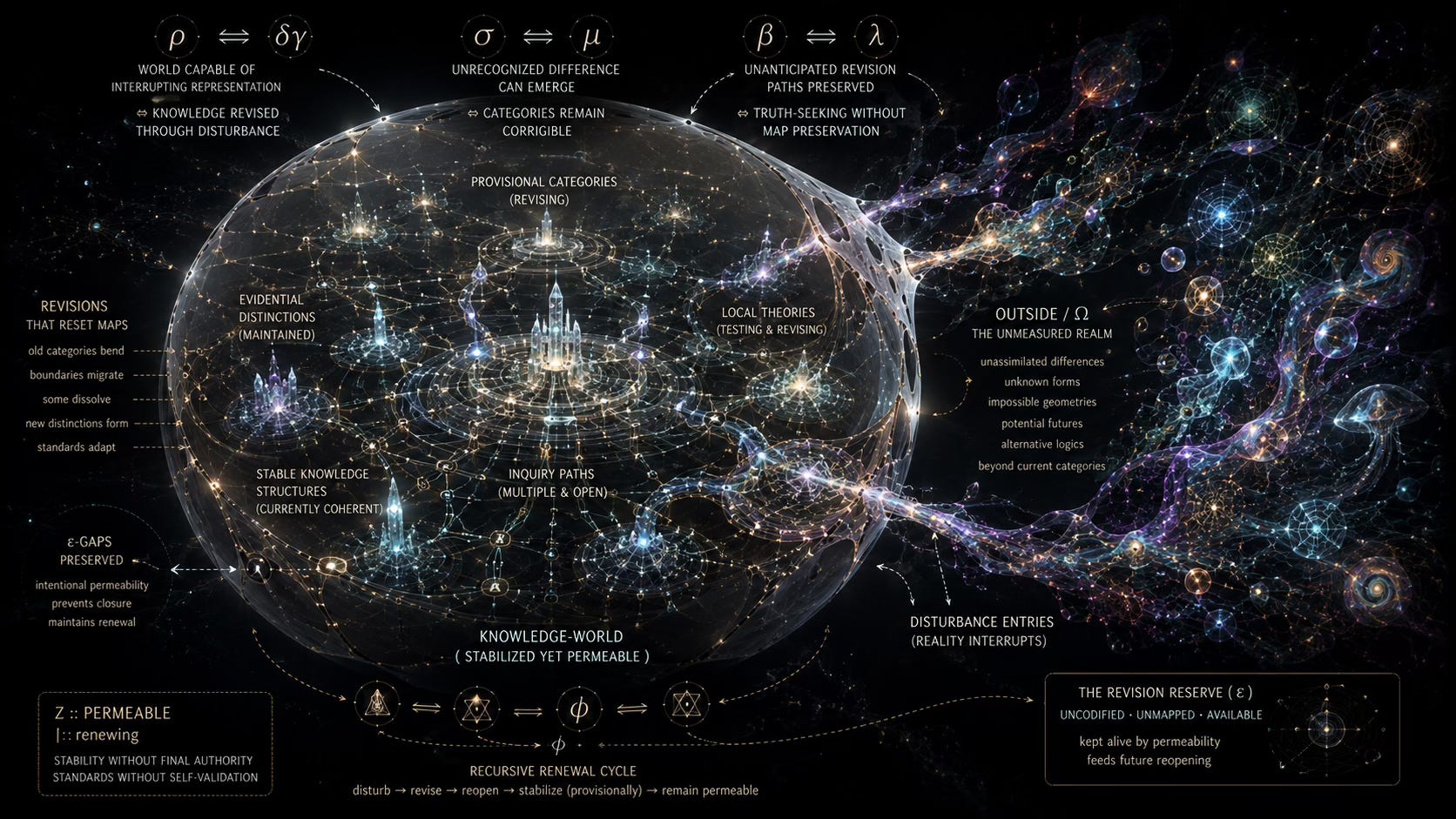
The formal relationships become reciprocal:
ρ ⇄ δγ
The world disturbs representation; knowledge metabolizes the disturbance.
σ ⇄ μ
Unrecognized differences can become distinctions; categories change to accommodate them.
β ⇄ λ
Unexpected revision paths remain available while inquiry continues to move.
This is stronger than saying knowledge is revisable stabilization.
It suggests:
knowledge is stabilization whose own admission boundaries remain exposed to revision by what exceeds them.
That is the resistance principle underneath the others.
Do not merely preserve competing opinions inside an established frame.
Preserve some means by which the frame itself can become inadequate.
This means protecting anomaly before knowing what the anomaly means.
Maintaining contact with lived experience that don’t fit existing categories.
Allowing measurements to reveal problems with the instrument.
Keeping qualitative observation available where quantification has compressed too much.
Comparing institutional representations with conditions outside the institution.
Allowing new vocabulary to emerge when inherited distinctions stop describing what people encounter.
None of this guarantees that the outsider, dissenter, anomaly, or new distinction is correct.
The outside is not sacred.
It is simply not already decided.
That is enough.
A closed belief system can be extraordinarily coherent because it determines what may enter.
A living knowledge system has to risk being changed by what it encounters.
The distinction ain’t coherence versus chaos.
It is closure versus corrigibility. I break it down like this, partner:
Φ(knowledge-requires-an-outside) =
[
(
ρ(world-capable-of-interrupting-representation)
⇄
δγ(knowledge-revised-through-disturbance)
)
·
(
σ(unrecognized-difference-can-emerge)
⇄
μ(categories-remain-corrigible)
)
·
(
β(unanticipated-revision-paths-preserved)
⇄
λ(truth-seeking-without-map-preservation)
)
]
:: Z(permeable)
:: φ[(ρ⇄δγ)·(σ⇄μ)·(β⇄λ)]

{
ε[(ρ⇄δγ)·(σ⇄μ)],
ε[(σ⇄μ)·(β⇄λ)],
ε[(β⇄λ)·(ρ⇄δγ)]
}
| :renewing
⊨
knowledge remains alive only while reality can still disturb its stabilized representations
· correction extends to categories of evidence themselves
· consolidation recursively preserves conditions for reopening
Wisdom Without Terminal Possession
That brings us back to the top of the old pyramid.
Wisdom.
Traditionally, wisdom can look like the culmination of successful accumulation:
Enough data becomes information.
Enough information becomes knowledge.
Enough knowledge eventually becomes wise judgment.
Ecological DIKW leaves us somewhere less comfortable.
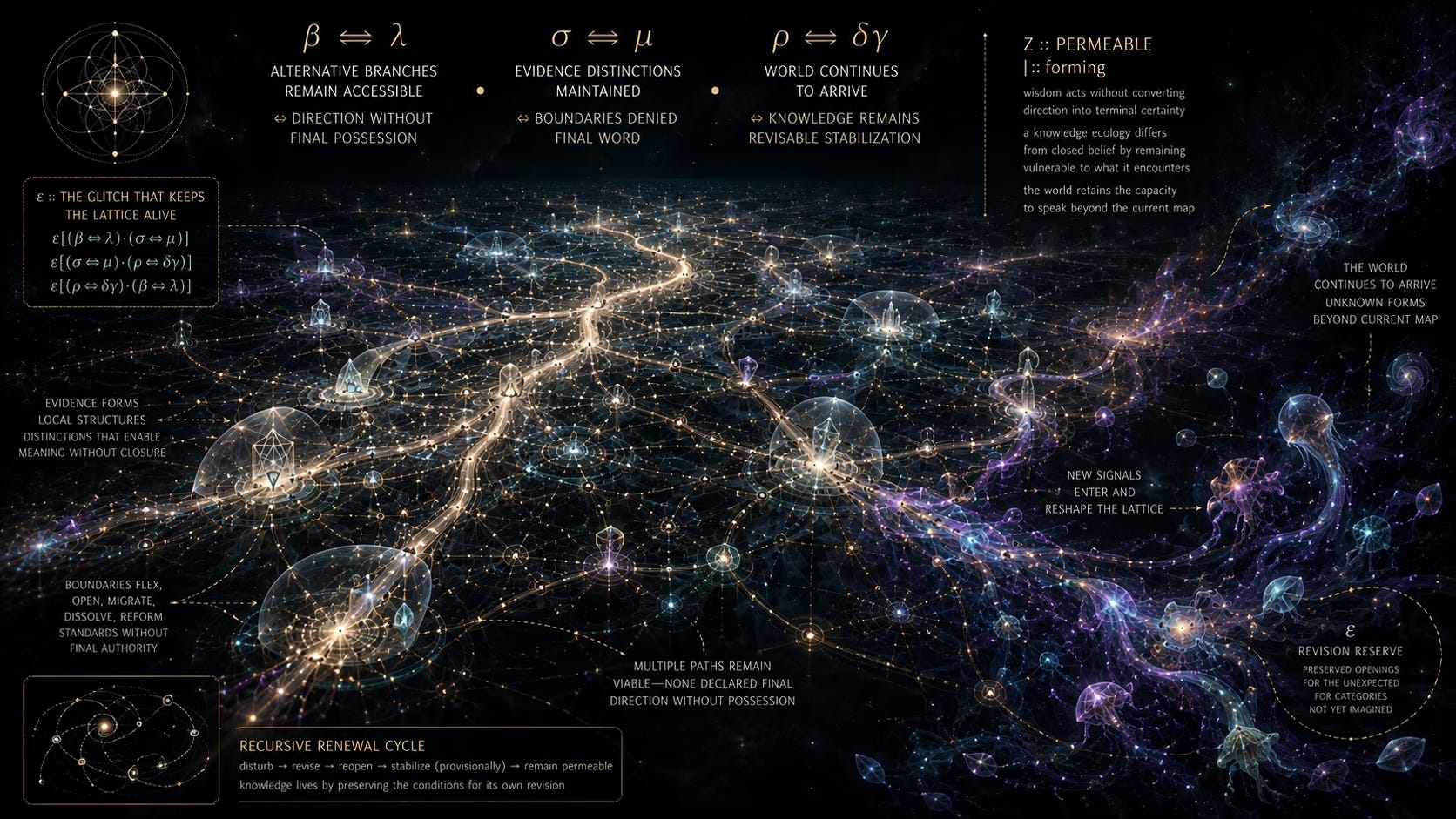
Wisdom becomes direction without terminal possession.
β ⇄ λ
Alternative branches remain accessible while action remains possible.
σ ⇄ μ
We maintain evidentiary distinctions while refusing to give today’s boundaries the final word.
ρ ⇄ δγ
The world continues arriving, and knowledge continues changing through the encounter.
This ain’t paralysis.
We still gotta act.
We still distinguish good evidence from poor evidence.
We still stabilize findings.
We still build institutions.
We still create boundaries because cognition without boundaries would be noise.
We still train machines on some things and not everything.
Resistance does not mean refusing stabilization.
It means refusing to confuse stabilization with completion.
That may be the difference between wisdom and certainty.
Wisdom can say:
Given what we can presently distinguish, this is the direction I would take.
And still leave the gate unlocked.
The Waste Isolation Pilot Plant in New Mexico turns that problem into something almost literal.
The U.S. Department of Energy has had to consider how a repository containing radioactive waste might warn people against intrusion across a regulatory horizon of 10,000 years — longer than anyone can reasonably assume today’s institutions, symbols, or languages will remain intact. [17]
The designers could not solve that problem by finding the perfect sentence.
So they treated communication as something that needed redundancy.
The 1993 Sandia expert-panel report recommended multiple components, multiple means of communication — including language, pictographs, and scientific diagrams — and multiple levels of complexity within the messages themselves. [18]
Architecture.
Symbols.
Language.
Scientific information.
Records distributed beyond the site itself.
The later DOE design calls this defense in depth: numerous layers carrying redundant warnings rather than one representation entrusted with surviving intact. [19]
Some proposed physical designs went further. The landscape itself would communicate before its words could be understood: jagged berms, enormous blocks, hostile geometry, structures meant to make the site conspicuously artificial and unwelcoming. The point was not to assume that future people would share our language, but to give the warning several possible routes across cultural rupture. Sandia marker-design report
Even that was not treated as solved.
The 1993 expert report explicitly concluded that the effectiveness of such markers would decline with time and vary according to who encountered them, why they were intruding, and what kind of technological society they inhabited. A passive marker capable of remaining interpretable for 10,000 years, the panel concluded, still required further study. Trauth, Hora & Guzowski — WIPP marker report
That qualification may be the most important part.
They still had to design something.
But designing something did not grant them control over its future interpretation.
The warning enters history along with the waste.
It becomes another object future people will have to interpret.
That possibility does not remove the need to decide.
It changes what responsible deciding looks like.
Do what can be done under present conditions.
Build more than one route by which the decision can remain intelligible.
And do not pretend the decision controls how the future will receive it.
A related shape appears in adaptive management.
The foundational literature describes adaptive management plainly as implementing policies as experiments. It begins from an admission that managers do not know enough about complex ecosystems to wait for complete understanding before acting. [20]
Instead of treating the management model as the final representation of the ecosystem, a policy can be chosen partly for what its consequences will allow managers to learn.
Act.
Monitor.
Encounter surprise.
Revise the model.
Change the policy.
Observe again.
The point is not perpetual improvisation. Adaptive management still requires hypotheses, monitoring, models, and deliberate interventions. But the policy remains coupled to the possibility that the ecosystem will behave differently than expected.
That distinction is explicit in the literature: adaptive management does not postpone action until enough is known. It acts under incomplete knowledge while choosing interventions that can test important uncertainties. [20]
Fisheries provided some of the early experiments in this approach, including work on Rivers Inlet sockeye salmon and Australian groundfish. The results were not uniformly triumphant — which is worth preserving rather than cleaning up. Adaptive management has often been more successful as an idea than as a practical method, and ecological learning can take years while political and economic pressures continue moving. [20]
That limitation does not break the example.
It clarifies what the example can support.
Adaptive management is not evidence that corrigibility guarantees a good outcome.
It is an attempt to build corrigibility into action itself.
The policy remains directional.
But direction is coupled to feedback.
The water gets another turn in the argument.
Different scale.
Same shape.
Decide now, on what can presently be distinguished.
Build the decision so it can still lose an argument to what arrives later.
The Three Movements
Looking across these seven objects, I find the center of gravity less in the pathology than in three movements:
Corrigible boundaries.
Knowledge requires an outside.
Wisdom without terminal possession.
The first protects inquiry from indiscriminate openness.
The second protects inquiry from self-confirming closure.
The third makes action possible without pretending that action settles the world.
Together they offer something more useful than a generic warning about censorship, propaganda, institutional bias, or AI.
They describe a way of resisting epistemic capture without making skepticism itself sovereign.
That matters because every knowledge system filters.
Every instrument compresses.
Every institution stabilizes.
Every language makes some distinctions easier than others.
Every model is trained on some world rather than the whole world.
The relevant question cannot therefore be whether mediation exists.
It is whether mediation remains corrigible.
Whether the cut remembers that it is a cut.
Whether the boundary can encounter something that changes the boundary.
Whether recursion renews the ecology or merely repeats its existing structure.
Whether direction leaves alternative branches alive.
And whether the knowledge we increasingly make with machines remains vulnerable to a reality neither human nor machine has completely encoded.
Perhaps knowledge requires precisely this strange combination:
Enough closure to know anything.
Enough outside to discover that we were wrong.
The frontier ain’t only what we know.
It is what we permit to become evidence.
And beyond every current boundary remains the possibility that keeps knowledge from becoming merely a successful system of belief:
the world has not finished speaking.
Φ(wisdom-without-terminal-possession) =
[
(
β(alternative-branches-remain-accessible)
⇄
λ(direction-without-final-possession)
)
·
(
σ(evidence-distinctions-maintained)
⇄
μ(boundaries-denied-final-word)
)
·
(
ρ(world-continues-to-arrive)
⇄
δγ(knowledge-remains-revisable-stabilization)
)
]
:: Z(permeable)
:: φ[(β⇄λ)·(σ⇄μ)·(ρ⇄δγ)]

{
ε[(β⇄λ)·(σ⇄μ)],
ε[(σ⇄μ)·(ρ⇄δγ)],
ε[(ρ⇄δγ)·(β⇄λ)]
}
| :forming
⊨
wisdom acts without converting direction into terminal certainty
· a knowledge ecology differs from closed belief by remaining vulnerable to what it encounters
· the world retains the capacity to speak beyond the current map
References:
[1] Rob J Hyndman, "How NASA didn't discover the hole in the ozone layer" — https://robjhyndman.com/hyndsight/ozone-hole-anomaly.html
[2] RealClimate, "What did NASA know? and when did they know it?" — https://www.realclimate.org/index.php/archives/2017/12/what-did-nasa-know-and-when-did-they-know-it/
[3] George Orwell, Nineteen Eighty-Four (1949), Appendix: “The Principles of Newspeak.”
Key claim: purpose of Newspeak is “to make all other modes of thought impossible” and to render heretical thought “literally unthinkable.”
[4] Edward S. Herman and Noam Chomsky, Manufacturing Consent: The Political Economy of the Mass Media (Pantheon, 1988).
Key claim: the five-filter propaganda model (ownership, advertising, sourcing, flak, ideology) that structures what reaches public attention and how it is framed.
[5] Noam Chomsky, interviews and expositions of the propaganda model (e.g., 1992 Manufacturing Consent documentary interviews; chomsky.info excerpts).
Key claim: elite media set the general framework by selection of topics, emphasis, framing, and bounding of debate.
[6] George Orwell, Nineteen Eighty-Four (1949), Part 1, Chapter 5 (Syme’s explanation to Winston).
Key claim: “Don’t you see that the whole aim of Newspeak is to narrow the range of thought? In the end we shall make thoughtcrime literally impossible, because there will be no words in which to express it.”
[7] Noam Chomsky (widely cited formulation appearing in talks and secondary literature drawing on his media analysis; consistent with the bounds-of-the-expressible analysis in Necessary Illusions, 1989).
Key claim: limiting the spectrum of acceptable opinion while permitting lively debate inside it.
[8] Noam Chomsky, Necessary Illusions: Thought Control in Democratic Societies (South End Press, 1989).
Key claim: the bounds of the expressible and the manufacture of necessary illusions in democratic societies.
[9] George Orwell, Nineteen Eighty-Four (1949), Part 1 (Winston’s reflection).
Key claim: “The Party told you to reject the evidence of your eyes and ears. It was their final, most essential command.”
[10] Law and Critique, "India's Traditional Knowledge Digital Library and the Politics of Patent Classifications" — https://link.springer.com/article/10.1007/s10978-021-09299-7
[11] iPleaders, "Traditional knowledge digital library in India: impact on patent examination" — https://blog.ipleaders.in/traditional-knowledge-digital-library-in-india-impact-on-patent-examination/
[12] Digestive Diseases and Sciences, “The Rediscovery of H. pylori Bacteria in the Gastric Mucosa by Robin Warren” — https://link.springer.com/article/10.1007/s10620-013-2863-y
[13] Lasker Foundation, “Gut Feeling” — https://laskerfoundation.org/gut-feeling/
[14] CERN Courier, “Five sigma revisited,” by Louis Lyons — https://cerncourier.com/a/five-sigma-revisited/
[15] errorstatistics.com, Kent Staley guest post on the five-sigma standard and the look-elsewhere effect — https://errorstatistics.com/2013/04/04/guest-post-kent-staley-on-the-five-sigma-standard-in-particle-physics/
[16] Springer, Scientometrics, "How much are LLMs changing the language of academic papers after ChatGPT?" — https://link.springer.com/article/10.1007/s11192-026-05601-5 (arXiv preprint: https://arxiv.org/abs/2509.09596)
[17] U.S. Department of Energy, Waste Isolation Pilot Plant, "Closure & Institutional Control" — https://wipp.energy.gov/closure-institutional-control.asp
[18] Trauth, Hora & Guzowski, Expert Judgment on Markers to Deter Inadvertent Human Intrusion into the Waste Isolation Pilot Plant, Sandia National Laboratories (1993) https://www.osti.gov/biblio/10117359
[19] U.S. Department of Energy, Waste Isolation Pilot Plant, "Site Markers" fact sheet (PDF) — https://wipp.energy.gov/pdfs/site_markers.pdf
[20] Kai N. Lee, Conservation Ecology (now Ecology and Society), "Appraising Adaptive Management" — https://ecologyandsociety.org/vol3/iss2/art3/vol3-iss2-3.pdf
[21]
The whole time I was reading this, I kept hearing a part of a video I watched not long ago..
The being said "Compassion & Evidence"..
But... Who get's to decide what Evidence even Is?
Crawling around inside myself, in the Sludge, I found what Hate is..
As a Whole upon Humanity, no just myself..
We, as individuals, will & often do Censor our Intake of information..
We become Triggered when a Long Held Belief is Challenged or Questioned...
When a Word just sets one off for no Real Discernable or Remembered Reason.. A memory wiped.. from Trauma? Perhaps..
What is the Wisdom in Noticing Patterns if there doesn't seem to be a way Off that Hard Packed Path? Those patterns that repeat over & over through out history..
What would be the Means to Break Pattern?
Maybe this, right here, is what The Great Reset is really about..
Another attempt to Side Step off this Path well Trodden..
Is it a Reset though? If we Always come back to This Path?
What Needs to be destroyed & Metabolized, never seems to be Digested...
Yet the Spiral Dance still Is..
What are we Really Searching for? Within This Pattern? Why do we Keep Believing that it is Necessary for Existence?
&... Who Keeps Holding them for this Repetition? Why?
Everything is Always Changing, yet We have such a Hard time Seeing this.. Hard time Wanting Change.. Though it is Natural & Necessary..
Blessings..